 Expert verified
 Mid-market businesses, family-owned enterprises and growing companies in India are increasingly turning to management consulting to help them handle growth, restructuring, and increasing operational complexity.
This guide breaks down what management consulting means, what it covers, how engagements work, and how to identify the right firm for your business.
What Is Management Consulting?
Management consulting refers to the practice of onboarding external specialists to solve specific business problems that your internal team cannot address effectively on its own.
These specialists assess a specific challenge that you are facing, analyse the situation objectively, and recommend, or sometimes implement, solutions.
Businesses brings in a management consulting firm for different reasons such as :
- The leadership team is too close to the problem to see it clearly
- A decision needs external validation before the board or investors will act
- The company lacks the in-house expertise for a specific challenge (a new market entry, a merger, a regulatory shift)
- Speed matters and building internal capability takes time a business doesn’t have
- An independent perspective is needed to break internal deadlock
Let’s understand this with an example:
You run a manufacturing unit in Surat. For the past few quarters, you’ve been struggling with yield losses and haven’t been able to pinpoint the real reason.
This is when you bring in a management consultant. The consultant studies the production line, identifies bottlenecks, and redesigns workflows.
With her/his expertise, the consultant, over the next few quarters, is able to help you boost operations, and develop a clear strategy for problem resolution.
Management Consulting Vs Outsourcing Vs Advisory
It is important to understand that management consulting is different from outsourcing and advisory.
Unlike outsourcing, in consulting, you’re not handing off a function, you’re bringing in expertise to help your internal team think sharper, move faster, or build capability they currently lack.
Also, unlike an advisor who only gives an opinion, a consultant delivers a result.
When you engage a consulting firm, you are not paying for opinions. You are paying for a structured process: discovery, analysis, solution design, and implementation support.
What Do Management Consultants Actually Do?
The scope of work of a management consultant can vary significantly depending on the engagement.
Short Engagement: An expert addresses questions around diversification into renewable energy.
Long implementation project: A consultant works with you for 6 months, analysing, reimagining and implementing new processes as well as training your supervisors to sustain them.
The common thread is independence. The consultants have no internal politics, so they can point out what’s broken without worrying about offending someone.
But at its core, management consultants do three things:
- Diagnose: They analyze financials, operations, processes, market position, or organisational structure to identify root causes of underperformance or risk
- Recommend: The consultants develop practical, prioritised recommendations based on company/organisation data and industry benchmarks
- Support implementation: In many engagements, particularly in India’s mid-market, consultants stay involved through execution.
Management Consulting Services in India
In India, the need for management consulting services is on a rise especially among mid-size and family-run businesses.
Navigating succession, professionalisation, or rapid scaling, these businesses going through professionalisation benefit the most from external expert assistance
Management Consulting firms operating in this space range include global giants like McKinsey, and Deloitte to mid-large Indian firms like PKC Management Consulting.
For many Indian businesses, especially outside the top metros, a firm with local market understanding and hands-on involvement often delivers the best value than a globally-branded name.
Strategies that work for multinationals in Mumbai may fail to be suitable for mid-market companies in Coimbatore due to differences in execution capacity, local supply chains, and organizational maturity.
A good consulting firm adapts and doesn’t just hand over a global template but build solutions that fit your business, your people, and your market.
Types of Management Consulting Services
Management consultancy services can cover a wide range of business functions from strategy, finance, and operations, to people, technology, or compliance.
Most mid tier firms offer several of these; and several boutique firms specialise in one or two.In order to match your service to the right expertise, you must understand these categories.
Before we get into the details, here’s a quick look at the main types:
| Service Area | Business Needs |
| Strategy | Growth, market entry, competitive positioning |
| Financial Advisory | Fundraising, MIS, working capital, CFO support |
| Operations | Process efficiency, supply chain, cost reduction |
| Organisational | Organisational design, performance systems, succession |
| Technology | Digital transformation, system selection |
| Compliance & Risk | Regulatory adherence, governance, audit readiness |
| M&A & Restructuring | Acquisitions, due diligence, business turnaround |
Strategy Consulting
This is the most well-known type where strategy consultants work with leadership on long-term planning and business direction.
Common scenarios where strategy consultants are brought in:
- Assessing potential acquisition targets
- Evaluating how to pivot product lines in response to market shifts
- Designing the right organizational structure for major events like an IPO
- Identifying which new markets to enter
- Defining long-term growth strategy (e.g., next 3–5 years)
The work is heavily analytical involving market sizing, competitive benchmarking, scenario planning, business model evaluation. Outputs are usually strategic roadmaps or recommendations for major decisions.
Financial Advisory and CFO Services
For many Indian SMEs, especially family-owned businesses, getting the financial architecture right is an immediate need.
Financial advisory consultants help you manage cash flow in a more streamlined manner, restructure debt with lenders, or prepare your books for a transaction.
They can also guide you through the valuation process when you are ready to bring in outside capital.
Covers services such as:
- Financial restructuring
- Working capital optimisation
- Fundraising strategy
- Budgeting frameworks
- MIS reporting
- Financial due diligence
A consulting firm offering CFO-level advisory can help businesses that aren’t yet at the stage of hiring a full-time CFO but need that level of thinking on their finances.
Operations Consulting
Operations consultants focus on how work actually gets done inside the business, be it supply chain, procurement, production, or logistics, and process efficiency.
The main aim is to find waste, remove bottlenecks, and improve throughput without increasing the cost proportionately.
With rising labour costs and fluctuating input prices, a company that reduces waste can undercut competitors or protect margins.
Operations consultants usually spend time on your shop floor or in your warehouses. They measure cycle times, map workflows, and implement changes like lean manufacturing or Six Sigma. The results: lower costs, faster turnaround, and fewer defects.
Our consultants at PKC have helped many manufacturing businesses improve margins, reduce procurement costs and cut inventory carrying costs. delivering measurable savings that scale with growth.
Organizational Design and Change Management
When a business is scaling fast or going through a transition, for example, a second-generation takeover in a family business, the organisational structure often hasn’t kept pace.
Organisational consulting helps build the systems that allow a company to perform consistently, rather than relying on a handful of key individuals.
This segment focuses on managing people within the organization.This involves:
- Organizational design
- Workforce planning
- Clear reporting structures
- Performance management frameworks
- Leadership development, and
- Compensation structuring.
Digital Transformation Consulting
In India, a large number of businesses are still in the process of digitising core operations like accounting, inventory, CRM, supply chain.
Technology consultants assess your current processes, identify where automation or data analytics can create leverage, and then manage the implementation of the right tools.
Making the wrong technology choice is expensive. Getting external guidance before committing to a platform saves time and money.
For a distributor with a network of dealers, this might mean moving from manual order taking to a mobile-based ordering system. For a manufacturer, it could mean installing IoT sensors on machines to predict maintenance needs before breakdowns occur.
The consultant’s job is to ensure the technology actually solves a business problem and that your team adopts it.
Compliance, Risk, and Governance Consulting
Indian businesses have to deal with many regulatory complexities.
GST, Companies Act, SEBI regulations, RBI guidelines, sector-specific compliance are only some of the main ones, and the list is constantly evolving.
Compliance consulting helps businesses structure their operations to handle all these requirements, manage risk, and build governance frameworks that satisfy regulators, lenders, and investors.
This is especially relevant for businesses preparing for external funding, listing, or an audit-intensive transaction.
Mergers, Acquisitions, and Restructuring
M&A consulting covers pre-deal strategy, target identification, due diligence, deal structuring, post-merger integration, and business restructuring. This is specialised work that most businesses encounter rarely — but when they do, the stakes are high enough to warrant expert support.
How a Management Consulting Engagement Works
If you are planning to work with a management consultant, educating yourself with the process makes things easier.
It helps set boundaries on what to expect, the impact on your regular business, the engagement rules and final outcome.
Most experienced consulting firms like PKC follow a structured path that minimizes disruption and maximizes results.
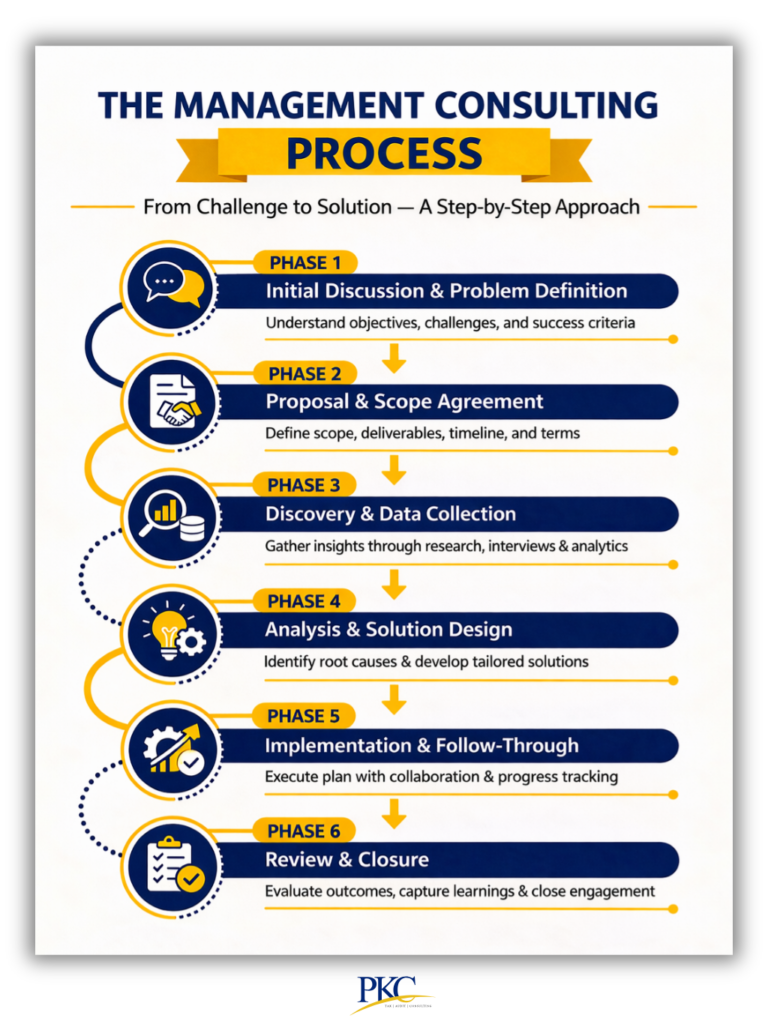
Although the specifics may vary depending on the type of problem and the firm you hire, here are the core stages:
Phase 1: Initial Discussion and Problem Definition
This is where you and the consulting firm define the problem.The consultant meets the business owner or leadership team to understand:
- what’s happening
- how long it’s been happening
- what’s already been tried
In many cases, the problem a business thinks it has and the problem it actually has are different. This phase helps get to the core of the issue.
Getting this right will determine if the rest of the engagement is useful.
Get your team ready for questions. A good consulting firm will ask uncomfortable questions here, which is the point.
Phase 2: Proposal and Scope Agreement
Once you’ve zeroed in on the problem, your firm puts together a proposal.
This outlines the scope of work (and what’s not in the scope as well), the approach, key deliverables, timeline, expectations from your internal team, and fees.
Pay attention to scope. Vague proposals lead to scope creep, misaligned expectations, and disappointment.
Before you sign, you should know specifically what you’ll receive, by when, and how success will be measured.
Engagement structures can be:
- Project-based: Fixed scope, fixed fee, defined timeline. Common for strategy work, due diligence, or specific operational reviews.
- Retainer-based: Ongoing advisory over a defined period. Common for CFO services, compliance advisory, or post-implementation support.
- Hybrid: A project engagement followed by a lighter retainer for implementation oversight.
Phase 3: Discovery and Data Collection
Next, the consulting team begins gathering data. They review financials, interview key personnel, analyse processes, examine existing data, and sometimes speak to customers or vendors.
In an operations engagement, for example they may spend days on your shop floor, tracking cycle times and observing workflows.
Consultants work with what they’re given, so business owners need to ensure they have access to all the important information. If critical information is withheld, whether due to sensitivity or internal reluctance, the analysis may have blind spots.
Business owners/ stakeholders must:
- Be open
- Make team available
- Resist the urge to manage consultant’s perception of the business.
Phase 4: Analysis and Solution Design
At this stage, the consulting team synthesises everything gathered in discovery, runs the relevant analysis, and prepares a solution.
This might involve market data, benchmarking against comparable businesses, and financial modelling.
The solution presented is not just a set of recommendations, it’s a collaborative effort.
The consultant presents findings and options including things you may not want to hear. You push back on what is unrealistic given your capital constraints or organizational culture.
Together, you refine the plan until it is both ambitious and achievable. The output is a practical roadmap with clear steps, timelines, and owners.
Phase 5: Implementation and Follow-Through
This phase separates good consultants from average ones. Implementation is where value actually gets created.
Many Indian businesses don’t have the internal bandwidth or change management experience to execute recommendations on their own. A consulting firm that stays involved through execution, even in an advisory capacity, improves outcomes significantly.
The consulting team works alongside your people to execute the roadmap. They may train your supervisors, help you select vendors, or manage the rollout of a new process.
However, not every engagement includes implementation.
Clients that have the internal capability, can execute once they have a clear plan. But if your business doesn’t, build implementation support into the scope from the start.
Implementation can last months or even years, depending on the complexity of the work. The consultant’s role gradually shifts from leading to coaching, transferring knowledge so your team can sustain the improvements after the engagement ends.
Phase 6: Review and Closure
Last comes the review and closure.
At the end of the engagement, the consulting firm reviews what was delivered against what was promised.
Key outcomes are documented. If the engagement was project-based, this is where it formally closes. If it transitions into a retainer, the terms are reset for the next phase.
A well-run engagement ends with the client team owning the outcome, not dependent on the consultant to maintain it.
Management Consulting for Indian Mid-Market Companies
India’s mid-market businesses (revenues between ₹50 crore and ₹1000 crore) occupy a unique space:
Large enough to have complex operations, multiple locations, and a significant workforce, but not so large to have internal specialisation, an in‑house transformation office, or the luxury of absorbing failed experiments.
Many of these businesses are family-owned or promoter-led and have grown significantly over the past decade.
What they still lack, however, are formalised systems, processes, or governance structures that sustained growth requires. That’s when consulting becomes relevant, to push them to the next level.
8 Unique Challenges Indian Mid-Market Businesses Face
- Founder dependency & succession gaps: Decision-making sits at the top. The founder or a small family group often is the business. When they step back, the organisation struggles to function independently.
- Professionalisation pressure: Growth and external capital comes with the need for structured reporting, accountability, and processes. Many promoters know they are needed but haven’t formalised them yet.
- Two way competition: Squeezed between large players with scale advantages and smaller startups that move faster without legacy constraints.
- Capital access & financial structure: Untapped credit, weak working capital design, and misrepresented balance sheets limit funding outcomes. Strong financial architecture is needed to improve terms.
- Operational inefficiency at scale: Informal processes that worked when the company was at ₹30 crore falls apart at ₹150 crore. The supply chain strains, inventory builds, and margins erode despite revenue growth.
- Talent & organisational structure: Roles within the company evolve informally. Few mid-market firms have built deliberate team structures or performance systems.
- Regulatory complexity: GST, tax, Companies Act, and sector rules create a heavy compliance burden that is difficult to handle and often beyond in-house capabilities.
- Expansion: Adding a new factory, entering a new state, or launching a new product line strains systems. Cash flow becomes harder to manage. Margins get squeezed.
Why External Consulting Works Well Here
In most cases, mid-market businesses are close to their problems but often fail to see them. Even when there is some internal expertise, internal politics or biases block any necessary changes.
An external consultant brings in a fresh unbiased perspective. In family businesses, this independence is especially valuable where sensitive issues around succession, compensation, or underperformance of family members need to be handled by someone who isn’t part of the system.
Plus, even if they have the resources, hiring a senior finance professional takes time. A consulting firm can deploy that expertise on demand, for the duration you need it, without the overhead of a full-time hire.
Where Mid-Market Companies Use Consulting
- Business restructuring and turnaround: When margins are under pressure or the business model needs rethinking
- Pre-funding readiness: Preparing financials, governance, and documentation before approaching PE investors or lenders
- Succession and family business governance: Structuring roles, responsibilities, and ownership transitions
- ERP and systems implementation: Selecting and deploying technology that matches the business’s actual scale and complexity
- Market expansion: Entering new geographies, product categories, or customer segments with structured planning
- Cost optimisation: Systematic identification of savings in procurement, operations, and overheads
How Much Does Management Consulting Cost in India?
The cost of management consulting in India varies widely. For mid‑market Indian companies, a typical consulting engagement ranges from ₹2 to ₹50 lakh per project. Some engagements may fall below this range; larger, multi‑year transformations can exceed it.
What you pay depends on the following factors:
- Seniority and expertise: Of the team assigned to your engagement
- Duration and complexity: Of the project
- Firm type: Global, pan-India, or boutique specialist
- Engagement structure: Project-based, retainer, or hybrid
- Deliverable depth: Advisory only, or advisory plus implementation
In addition to these, some other costs that you should account for may include
- Travel and accommodation if consultants need to be on‑site
- Third‑party tools or software that may be required for implementation (e.g., CRM, analytics platforms).
- Internal team time, your people will spend time in interviews, workshops, and data gathering. Factor in the opportunity cost.
Fee Ranges by Firm Type
Global consulting firms (e.g., McKinsey & Company, Deloitte, PwC, KPMG)
Day rates for senior consultants can range from ₹1.5–5 lakh per day. The project costs can run anywhere from ₹50 lakh to several crores. Their pricing and minimum engagement sizes make them largely inaccessible to small and medium businesses.
Mid-size Indian consulting firms (PKC Management Consulting)
This is where you get value driven results without the Big 4 price tags. The project fees for such firms can be anywhere between ₹5–50 lakh with senior advisory retainers running between ₹1–8 lakh per month.
Boutique and specialist firms
Fees vary widely for these firms. A niche specialist, let’s say, a firm focused exclusively on family business succession might charge premium fees for their specific expertise but still below large firms. Retainers can start around ₹75,000 per month for lighter engagements.
Approximate Fee Ranges by Engagement Type
| Engagement Type | Typical Fee Range (India) |
| Strategic review / business diagnostic | ₹5 lakh – ₹25 lakh |
| Financial restructuring / CFO advisory (project) | ₹3 lakh – ₹20 lakh |
| Ongoing CFO / financial advisory (retainer) | ₹1.5 lakh – ₹6 lakh/month |
| Operations and process improvement | ₹8 lakh – ₹40 lakh |
| HR and org design | ₹5 lakh – ₹20 lakh |
| M&A due diligence and advisory | ₹10 lakh – ₹75 lakh+ |
| Compliance and governance | ₹2 lakh – ₹15 lakh |
| Full business transformation | ₹25 lakh – ₹2 crore+ |
Pricing Models Used by Consulting Firms
Fixed-fee projects: These are the most common for defined-scope work. You know the cost upfront, which makes budgeting straightforward. The risk is that scope creep changes to deliverables mid-engagement and can lead to renegotiation.
Monthly retainers. They work well for ongoing advisory relationships, particularly for CFO services, compliance support, or post-project implementation oversight. You have consistent access to senior expertise without committing to a large upfront fee.
Time and materials: Here you’re charged by the hour or day. This is less common in India for mid-market engagements, but do appear in open-ended or exploratory work. Be cautious with this structure unless there’s a clearly defined cap.
Value Based/ Success-based fees. This kind of pricing is occasional. A portion of the fee is tied to a defined outcome like a fundraise completed, a cost reduction achieved. These can work well but require very clear upfront agreement on how success or value is measured.
Cost Versus Value: The Right Way to Think About Consulting Costs
Focusing only on the fee alone misses the point. The better question is: what return will I get?
If a six-month operations engagement costs ₹20 lakh and delivers ₹80 lakh in annual cost savings, the payback is less than three months.
That said, not every engagement can be measured in tangible ROI terms. Governance improvement, succession planning, and risk management create value that’s harder to quantify.
Typical Outcomes — ROI from Consulting Engagements
Industry‑level benchmarks suggest that top strategy consulting engagements can deliver about 5–10x return on fees within 12–18 months. Operational projects also see 3–8x returns, depending largely on how well recommendations are implemented.
At PKC Management Consulting, our work across manufacturing, financial services, and family-owned businesses shows that well-executed advisory often delivers returns that exceed costs, mostly within the first year.
Here are some realistic benchmarks for the most common types of work:
| Outcome Area | Benchmark / Impact |
| Cost reduction | 8–15% savings on addressable costs |
| Working capital | 15–25% reduction |
| Revenue growth | 10–20% upside via pricing, sales, expansion |
| Fundraising & capital access | Fees 1–3% of capital; improves funding terms |
| Process efficiency | 10–20% improvement in cycle times/throughput |
| Systems & technology | Reduces ERP/system implementation failures |
| Leadership & succession | Mitigates disruption from unplanned transitions |
| Talent retention & performance | Reduces attrition of key staff |
Financial Outcomes
Cost reduction: Operations and procurement engagements typically target 8–15% savings on addressable costs. For a ₹200 crore manufacturing business, even a 5% cut in total operating costs yields ~₹10 crore annually. This far exceeds your typical consulting fee.
Working capital improvement: Financial advisory engagements can unlock 15–25% reductions in working capital through better debtor management, tighter inventory control, and improved creditor terms. For capital-intensive firms, this frees up ₹5–15 crore in cash, directly improving liquidity and lowering financing costs.
Revenue growth: This is harder to attribute cleanly to consulting, but strategy engagements can identify 10–20% revenue upside via pricing optimization, market expansion, and stronger sales execution.
Fundraising and capital access: Pre-funding advisory helps clean up financials, sharpen the narrative, and prepare for investor scrutiny. This can determine whether capital is raised and on what terms. Fees are typically 1–3% of the capital involved.
Operational Outcomes
Process efficiency: Structured operations consulting can deliver tangible gains in order-to-delivery cycles, production throughput, and error rates. A mid-sized manufacturer for instance that cuts production cycle time by 15% effectively gets additional capacity without new capex, creating real economic value.
Systems and technology: ERP or business management system advisory and implementation helps avoid costly missteps. Industry estimates suggest that over half of ERP implementations in mid‑market businesses face significant cost overruns or meaningful functionality gaps. Good consulting reduces that risk, improving cost control, system fit, and long-term usability.
Organizational Outcomes
Leadership and succession: Structured succession planning in family businesses mitigates the financial, operational, and relational disruptions that often accompany unplanned transitions. While hard to quantify, the cost of a poorly managed succession can threaten the very survival of the business.
Talent retention and performance: Organisational consulting that clarifies roles, improves compensation structures, and implements effective performance management systems can measurably reduce attrition. Replacing a senior manager typically costs 50–150% of their annual salary, considering recruitment, onboarding, and lost productivity. For a leadership team of ten, preventing just two departures per year creates clear, tangible value.
Reasons Your Management Consulting Engagement Didn’t Deliver
- Recommendations not implemented: This is the most common reason consulting doesn’t deliver value. A well-researched, well-presented report lying in a drawer somewhere changes nothing.
- Wrong problem scoped: The engagement was designed to solve the presenting symptom, not the root cause.
- Insufficient client engagement: The consulting team didn’t get access to the right people, the right data, or honest conversations about what was actually happening in the business.
- Leadership resistance to findings: Particularly true for family businesses. Recommendations that threaten existing power structures or require difficult decisions about people are sometimes shelved rather than acted on.
- Poor firm selection: The firm had the credentials but lacked the relevant experience, or deployed junior staff after senior partners sold the engagement.
How to Choose the Right Management Consulting Firm
While choosing a good consulting firm can give you a positive ROI, the wrong choice wastes time, money, and the window in which the problem needs to be solved.
Here’s how you should evaluate firms with the right criteria.
Start with Relevance, Not Brand
A globally recognized firm name isn’t a substitute for relevant experience. What matters is whether the firm and the specific team assigned has tackled similar problems in businesses of comparable size and complexity, ideally in your sector.
Ask firms directly:
- Can you share 2–3 examples of engagements like ours in scope and sector?
- What were the outcomes?
- Who led those engagements, and will they work on ours?
The last question is very important. In large firms, senior partners often sell the engagement while junior consultants execute it. You need to know who will actually be working with your team.
Assess Fit for Your Business Scale
A firm built for large corporations may struggle with a ₹150 crore family business, not for lack of skill, but because their methodology, fee structure, and engagement model are designed for a different scale. Outputs often reflect this mismatch.
Conversely, a small boutique advisor may have domain expertise but limited bandwidth for a complex, multi-workstream engagement.
For most Indian mid-market businesses, the right fit is a firm that:
- Uses a structured methodology flexibly
- Has experience with businesses in the ₹50–500 crore range
- Understands promoter-led or family-owned business dynamics
- Delivers outcomes, not just reports
Evaluate the Team You Will Actually Work With
Consulting quality is delivered by people, not by organisations. Two teams from the same firm can produce vastly different results.
When you’re in the evaluation process, insist on meeting the specific team that will handle your engagement.
Look for:
- Seniority and direct experience: Has the engagement lead personally worked through similar problems, or are they managing a team of analysts who will?
- Communication style: Do they explain things clearly? Will your internal team be able to work with them?
- Willingness to challenge: A good consultant will push back on your framing of the problem if they think it’s incomplete. A firm that simply agrees with everything you say in the sales process will likely do the same during the engagement.
Understand What’s Actually Being Delivered
Get specific about deliverables. A proposal that promises “strategic recommendations and a roadmap” is vague.
Before you sign, the scope document should answer:
- What specific documents, models, or frameworks will be delivered?
- At what stages will findings be reviewed with leadership?
- What does implementation support include — and what does it explicitly exclude?
- How is success defined, and how will it be measured?
Firms that resist this level of specificity are worth approaching cautiously.
Demand Implementation Capability
Many firms deliver excellent strategy reports. Few deliver results. The difference is whether they stay to implement.
Ask each firm you evaluate:
- Who is responsible for implementation?
- Do you provide post‑project support?
- How do you transfer knowledge to my team?
If the firm’s engagement model ends with a presentation, you will be left holding a document and no one to execute it. The right firm for a mid‑market company offers hands‑on support—working alongside your people, training them, and staying until changes are embedded.
Local Knowledge and Accessibility Matter
For Indian mid-market businesses, especially those outside the top metros, a consulting firm’s familiarity with the local regulatory environment, industry ecosystem, and business culture is a genuine advantage.
Understanding how banks, tax authorities, and sector regulators actually operate in practice shapes the quality of advice.
Accessibility matters too. A firm that isn’t reachable when you have an urgent question mid-engagement, or that treats your account as low-priority between formal deliverable milestones, isn’t functioning as a genuine advisor.
Red Flags to Watch Out for
| Red Flag | What It May Mean |
| Vague scope with broad promises | Poorly defined engagement ahead, risk of scope disputes |
| Senior partners selling, junior teams executing | The expertise you evaluated won’t be on your engagement |
| No clear implementation support | Recommendations without follow-through |
| Resistance to defining success metrics | Difficulty holding them accountable to outcomes |
| Generic proposals not tailored to your problem | Template-driven approach, limited actual thinking |
| Pressure to decide quickly | Sales behaviour, not client-focused behaviour |
PKC’s Management Consulting Practice — 37+ Years
Since 1988, we at PKC, have worked alongside Indian businesses across manufacturing, retail, healthcare, education, and more.
When clients asked us to solve bigger problems: operational inefficiencies, broken processes, and strategic roadblocks, we grew into a full‑service consulting firm.
Today, we offer businesses of all sizes a wide range of services under one roof so they don’t juggle multiple advisors.
- Experience across sectors: Our client list spans manufacturing, retail, healthcare, education, and professional services. We understand the pressures of scaling in India. the regulatory complexity, the talent constraints, the need for practical solutions.
- A multidisciplinary team: Our 200+ professionals include CAs, engineers, and Six Sigma‑certified consultants. A financial restructuring requires accounting expertise; a supply chain overhaul requires operations experience. We bring both.
- Hands‑on implementation: We do not hand over reports and walk away. Whether it is ERP implementation, supply chain optimization, or preparing a business for funding, we stay until changes are embedded in your operations.
- Measurable outcomes: We have helped clients eliminate 1.5 lakh invoices worth of processing time annually, optimized stock by 11 percent for a ₹200 crore retailer, and automated finance functions for over 300 clients. Our work is measured in results, not presentations.
For 37 years, we have operated on one principle: your business deserves the same quality of expertise that large corporations access.
We deliver that with local knowledge, hands‑on involvement, and a commitment to outcomes that improve your bottom line.
Evaluating consulting support for your business? Book a free consultation with PKC’s team to discuss your specific situation.