 Expert verified
 In India, the need for operations management consulting is rising sharply. Rising input costs, tighter working capital, and increased competition strain operational inefficiency.
Operations consultants provide a structured path to solve this problem.
This guide explores how operational excellence consulting turns business complexity into clarity. Learn how it converts hidden friction into measurable margin, building a genuinely resilient business operation.
What Is Operations Management Consulting?
Operations management consulting refers to the practice of identifying inefficiencies in how a business runs and fixing them.
An operations consultant examines your processes, workflows, and resources that turn inputs into outputs. Based on the analysis the expert recommends specific changes that reduce waste, lower costs, and improve output.
The goal is not a one-time fix but a durable improvement in how you operate day to day. This includes everything from redesigning factory floor layouts to rethinking supplier contracts or digitizing manual workflows.
The engagement is structured and the scope varies. A supply chain consulting project might focus entirely on reducing raw material lead times, while another engagement might span the entire plant: looking at layout, throughput, manpower productivity, and rejection rates simultaneously.
Why Indian Businesses Need Operations Management Consulting
The reality of many businesses in India is that processes have evolved organically instead of a well thought out strategy.
- What worked a few years ago simply stayed
- A temporary workaround became permanent
- Manual steps were never automated
- And slowly, these small inefficiencies began to stack up
Result: Output increases, but margins shrink. Lead times stretch. Customer complaints begin to surface.
The main reason wasn’t a lack of effort, but that the underlying operations were never designed to scale.
Today most companies operate in a hybrid system: part modern, part legacy. These include large-scale manufacturing setups to fragmented logistics networks and rapidly expanding service sectors. This creates a gap.
What Operations Consultants Actually Do:
An operations consultant helps bridge it by combining global best practices with a grounded understanding of Indian realities:
- Inconsistent infrastructure
- Wide variations in labor skill levels
- Complex regulatory requirements
- Vendor reliability challenges, especially across Tier 2 and Tier 3 cities
Operations management consulting goes far beyond identifying surface-level problems.
It’s about building a clear, data-backed understanding of how your business runs end to end – from procurement and production to quality, inventory, and last-mile delivery.
Using tools like process mapping and root cause analysis, consultants identify exactly where time, cost, and effort are being lost.
The impact is measurable: lower costs, faster turnaround times, improved quality, and better delivery performance, often significant enough to shift profitability.
If your business is growing but operations are struggling to keep up, or margins are tightening without a clear reason, it’s a signal. Operations consulting provides the clarity and roadmap you need to scale efficiently and sustainably.
Key Areas — Supply Chain, Production, Quality, Logistics
Operations management consulting is not just one service, it’s a cluster of interconnected areas, each representing a distinct source of cost, delay, or risk.
Together, they determine how reliably you deliver value to customers.
For example: A problem in your supply chain will show up on your production floor. A quality issue will surface in your logistics costs.
An experienced operations consultant looks at how they interact, not just how each one performs on its own:
| Area | KPIs Tracked |
| Supply Chain | Lead time, vendor rejection rate, procurement cost |
| Production | OEE, cycle time, rework rate, downtime |
| Quality | Defect rate, COPQ (Cost of Poor Quality), customer returns |
| Logistics | Freight cost per unit, order fulfilment rate, delivery TAT |
Here’s what each area involves and how it’s important for your business
Supply Chain
Supply chains govern how your raw materials move in, how inventory flows through your facilities, and how finished goods reach buyers.
Supply chain consulting in India is fairly challenging. It addresses some of the most complex problems like
- high lead times
- unpredictable transit
- Inconsistent raw material quality
- mix of organized and unorganized suppliers.
Rationalising it is extremely important. For manufacturers, for instance even a single unreliable tier-2 supplier can cascade into missed delivery commitments downstream.
The main role of an operations consultant here is to build a reliable, cost-efficient supply network in a fragmented market. They focus on vendor rationalisation, multi-sourcing strategies, procurement process design, and demand-supply planning.
Consultants are also involved in building practical contingencies for regional logistics disruptions, GST compliance across state lines, and managing suppliers who operate largely on informal systems.
Production
Production consulting looks at how efficiently your plant or facility converts inputs into finished goods. It covers assessing:
- plant layout
- line balancing
- capacity planning
- workforce deployment.
Indian manufacturing units, especially small and medium‑scale, frequently operate with underutilized equipment, excessive changeover times, or uneven workflow that creates piles of work-in-progress inventory.
An operations consultant looks at your production floor with fresh eyes. They measure cycle time, identify constraint operations using Theory of Constraints principles, and redesign layouts to minimize movement.
Consultants often find problems like uneven production lines, where some stations are overloaded while others are underused; inefficient changeovers that reduce productive time, and scheduling that doesn’t reflect actual demand.
Interventions range from line balancing and layout redesign to production scheduling systems and standard operating procedure(SOP) development.
Quality
Quality issues are expensive. That doesn’t just mean in rework and scrap costs, they show up in customer returns, warranty claims, and reputational damage.
Yet in many businesses, quality management is reactive. Problems are addressed after they occur rather than built out of the process.
Operation consultants shift quality from inspection-based to process-based. That means:
- identifying the root causes of defects (not just catching them at the end of the line)
- implementing Statistical Process Control (SPC) where relevant
- developing quality plans tied to production stages
- building accountability into the shop floor rather than concentrating it in a QC department.
Example: For a consumer goods company in Gurugram, implementing basic quality tools reduced defect rates by 40% percent within six months. This freed up inspection resources for higher-value work and reduced the friction between production and quality teams.
Logistics
Logistics consulting covers the movement of goods, inbound raw materials, inter-plant transfers, and outbound finished product distribution.
In India, logistics accounts for a significant portion of operating costs and can be a real opportunity for businesses to optimise.
Consultants look at logistics holistically. They help businesses with
- route optimisation
- warehouse layout and slotting
- freight cost benchmarking
- carrier management
- last-mile delivery efficiency.
For companies with pan-India distribution, network design (where to locate warehouses, how to configure regional distribution) can have a material impact on both cost and service levels.
Common Operational Problems in Indian Businesses
Indian businesses face several operational problems that show up repeatedly across manufacturing, distributors, and service businesses.
Here’s a look at the most common issues:
1. Processes Built on Informal Knowledge
In many SMEs and even mid-sized enterprises, critical operational knowledge is not documented.
The senior production supervisor knows why a particular machine behaves a certain way, the purchase manager has an informal understanding with three key vendors. When these people leave, so does the know-how.
This makes scaling harder and quality inconsistent. It also makes it nearly impossible to diagnose problems systematically, because there’s no documented baseline to measure against.
2. Inventory Mismanagement
Too much stock and too little stock often coexist in the same business. Example: A business may have excess inventory of slow-moving SKUs while fast-moving materials run short.
This is a symptom of poor demand forecasting and weak inventory control systems.
For Indian manufacturers, this problem gets worse because of unreliable supplier lead times, which push procurement teams to over-order as a buffer.
Additionally cost issues are huge and sometimes unmanageable: working capital gets locked up, warehouse space gets consumed, and material obsolescence quietly eats into margins.
3. Inconsistent Quality and High Rework
Defect rates in manufacturing operations are often accepted as a normal cost of doing business rather than treated as a process failure.
Rework gets absorbed into the production cycle without being measured or costed accurately.
The actual Cost of Poor Quality (COPQ). which includes scrap, rework labour, machine time, customer returns, and expediting costs. Is way higher than what shows up in reporting.
4. Vendor Dependence and Supply Variability
Many Indian businesses rely on one or two vendors for critical inputs, with no qualified backup. When that vendor misses a delivery or sends a substandard batch, the entire production schedule is disrupted.
Beyond single-source risk, vendor quality inconsistency is a persistent problem, especially when suppliers are smaller, informal operations that lack their own quality systems.
Managing this requires active vendor development, not just reactive complaint resolution.
5. Weak Production Planning
Production schedules in many facilities are built on optimism rather than data. Capacity constraints, material availability, and machine downtime aren’t adequately factored in.
The result: Teams spend more time reacting to breakdowns in the plan than executing a functioning one.
Poor planning also drives excessive overtime, which inflates labour costs while reducing output quality, fatigue on the shop floor has a measurable impact on defect rates.
6. Siloed Functions
Procurement, production, quality, and logistics often operate as separate functions with separate priorities and limited coordination.
Procurement chases the lowest price without considering supplier reliability. Production pushes volume without communicating with quality. Logistics is notified too late to plan efficiently.
This lack of integration is especially felt in businesses that grew quickly without building cross-functional processes to match that growth.
7. Limited Data Visibility and Underutilized Technology
ERP systems are purchased, partially implemented, and then used as expensive spreadsheets. IoT sensors get installed on machinery but the data isn’t acted on.
Warehouse management systems sit unused while stock is still tracked on Excel and handwritten logs.
When something goes wrong, finding the root cause takes days because data is scattered. This lack of visibility prevents proactive management. You spend your time firefighting instead of improving.
8. Resistance to Standardization
SOPs exist in some form in most businesses. Whether they’re followed is a different matter. On the shop floor, experienced workers frequently default to personal methods over documented ones.
Middle management often lacks the tools or the authority to enforce adherence consistently. This results in output variability that’s difficult to diagnose because the process itself isn’t stable enough to measure.
9. Workforce Skill Gaps and High Attrition
Skilled labor is available, but training is often informal. New operators learn from experienced workers, passing on both good and bad practices.
High attrition in manufacturing and logistics means you constantly lose trained people. The absence of standardized work instructions meant each new hire had to relearn processes from scratch.
10. Inefficient Production Layout and Flow
Factories in India frequently grow organically. Equipment is added where space allows, not where process flow demands.
This creates crisscrossing material movement, high work-in-progress inventory, and long cycle times.
How Operations Consultants Diagnose Issues
Diagnosis makes all the difference in consulting engagements, separating it from general advice.
A shallow i.e. based on a few conversations and a surface walkthrough, will give generic solutions. In rigorous ones, the interventions will be precise and the results defensible.
Here’s how a structured operational diagnosis works with trusted operations consulting firms like PKC:
Step 1: Understanding the Business Context
Before touching any process, a skilled operations consultant first understands the business model, revenue drivers, cost structure, and competitive pressures.
A textile exporter in Tirupur for instance may face very different priorities than a pharmaceutical manufacturer in Vadodara or a 3PL warehouse operator in Delhi NCR.
This context determines which problems matter most, what trade-offs are acceptable, and what improvement targets are realistic given the company’s stage and resources.
Step 2: Go to the “Gemba”
In most cases, the next step is going to the place where value is created – shop floor, warehouse dock. In the dispatch yard. Consultants call this the gemba—the real place.
They spend hours observing work as it happens, without interrupting operators. They watch material flow, note waiting times, count movements, and identify where decisions get made.
This can mean standing beside a machine operator through an entire shift. It means walking the length of a warehouse with a stopwatch.
The patterns that emerge from direct observation often contradict what is reported in meetings.
Step 3: Data Collection and Current State Mapping
Consultants gather both quantitative and qualitative data across the operations they’re reviewing.
Quantitative data typically includes:
- Production output vs. planned capacity
- Rejection and rework rates by process stage
- Inventory levels by category (raw material, WIP, finished goods)
- Procurement lead times and vendor performance records
- Machine downtime logs and maintenance histories
- Logistics costs by lane, carrier, and SKU
- OEE (Overall Equipment Effectiveness) by line or machine
Qualitative inputs come from:
- Structured interviews with plant managers, supervisors, procurement heads, and shop floor workers
- Direct observation like walking the production floor, shadowing a shift, watching how material moves through the facility
- Review of existing SOPs, quality plans, and operational reports
The gap between what the data says and what actually happens on the ground can be significant. Experienced consultants know to reconcile both.
Step 4: Process Mapping
Once data is collected, consultants build a detailed map of current processes using tools like Value Stream Mapping (VSM) in manufacturing or swimlane diagrams for cross-functional workflows.
Process maps reveal where work flows smoothly, where it stalls, where handoffs break down, and where steps persist out of habit rather than necessity.
A well-built VSM highlights the ratio of value-added time to total lead time. In many Indian manufacturing facilities, this ratio is far lower than expected.
Step 5: Root Cause Analysis
Identifying a problem is not the same as understanding it. Consultants use structured root cause analysis tools uncover the true drivers of underperformance.
For example: Frequent machine downtime isn’t a maintenance problem, it might be operator training gaps or poor preventive maintenance scheduling.
Common tools:
| Tool | Best Used For |
| Fishbone (Ishikawa) Diagram | Quality defects, process failures |
| 5 Whys | Recurring operational problems |
| Pareto Analysis | Identifying the 20% of causes driving 80% of impact |
| Fault Tree Analysis | Complex, multi-factor breakdowns |
Step 6: Benchmarking
Once the current state is mapped, it needs context.
Benchmarking compares your operational metrics against industry standards, sector peers, or best-in-class operations.
This step answers the question: how big is the gap, and is it worth closing?
For Indian businesses, relevant benchmarks exist across sectors: manufacturing OEE benchmarks, logistics cost norms as a percentage of revenue, procurement savings targets, and inventory turnover ratios by industry.
Step 6: Synthesize and Prioritize
Diagnosis ends with a clear picture: the current state mapped, baseline metrics established, root causes identified, and opportunities quantified.
Consultants present findings in a structured format, often using a dashboard that highlights the biggest gaps and the highest-impact interventions. This becomes the foundation for the improvement plan.
The diagnostic phase typically takes two to four weeks, but it doesn’t require halting operations or hiring external analysts. What it does require is disciplined observation, structured data collection, and the willingness to see operations as they truly are.
Lean Six Sigma in Operations Improvement
Often mentioned together, Lean and Six Sigma are two different and most widely applied methodologies in operations consulting.
Let’s break them down:
Lean: Eliminating Waste
Lean originates from the Toyota Production System and centers on one idea: eliminate everything that doesn’t add value for the customer.
This means removing waste from processes (not cutting corners), and eliminating steps, delays, and activities that consume resources without producing useful output.
Lean classifies eight types of waste, often remembered by the acronym DOWNTIME:
| Waste Type | What It Looks Like in Practice |
| Defects | Rework, scrap, customer returns |
| Overproduction | Making more than current demand requires |
| Waiting | Idle time between process steps |
| Non-utilised talent | Skills and knowledge going unused |
| Transportation | Unnecessary movement of materials |
| Inventory | Excess stock at any stage |
| Motion | Unnecessary movement of people |
| Extra processing | Steps that add no customer value |
In Indian manufacturing and warehouse operations, overproduction and waiting are often the most costly, and least visible, forms of waste.
Production teams may push output to meet volume targets without confirming whether downstream processes or customer schedules can absorb it.
Materials pile up between stages because handoffs aren’t synchronized. These wastes rarely appear as line items on a P&L, but they consume capacity, space, and working capital.
Lean Tools: Common tools for operations improvement include:
- 5S: Workplace organization and standardization
- Kaizen: Continuous, incremental improvement
- Kanban: Pull-based inventory signals
- SMED: Rapid changeover reduction
- Poka-Yoke: Error-proofing
The effectiveness of each tool depends on the waste being targeted. Applying 5S to every problem, for instance, treats Lean as a checklist rather than a diagnostic approach.
Six Sigma: Reducing Variation
While Lean focuses on speed and waste, Six Sigma emphasizes consistency and quality.
Its core idea is that most quality problems aren’t random, they stem from variation in the process. Reduce variation, and defect rates drop.
Six Sigma follows a structured problem-solving framework called DMAIC:
- Define: Clearly articulate the problem, its scope, and business impact
- Measure: Quantify the current state using data; establish a baseline
- Analyse: Identify root causes of variation and defects
- Improve: Design and implement solutions targeting root causes
- Control: Establish monitoring systems to sustain improvements
The term “Six Sigma” refers to a defect rate of 3.4 defects per million opportunities, a level of consistency most businesses don’t fully target, but the methodology’s statistical tools help move processes meaningfully toward it.
In India, Six Sigma is especially relevant in industries where quality consistency affects customer retention or regulatory compliance. For example, auto components, pharmaceuticals, food processing, and precision engineering.
A supplier to a Tier 1 automotive OEM must meet strict PPM (parts per million defect) targets. Tools like Statistical Process Control (SPC) provide the process discipline needed to consistently meet such specifications.
How Lean and Six Sigma Work Together
Lean and Six Sigma complement each other in practice.
Lean accelerates processes by eliminating waste, while Six Sigma stabilizes them by reducing variation. Combined, as in “Lean Six Sigma”, they tackle both speed and quality simultaneously.
A combined approach works in sequence:
- Lean first: Streamline production flow, remove non-value-added steps, and reduce delays.
- Six Sigma next: Apply statistical tools to the remaining steps to reduce defects and ensure consistency.
Optimizing a wasteful process with Six Sigma before removing waste is inefficient, the sequence matters.
Practical Reality of Lean Six Sigma in Indian Operations
Lean Six Sigma has seen mixed results in India. This is not because the methodology is flawed, but because of how it’s applied. Common pitfalls include:
- Training operators and supervisors on tools without building the underlying process discipline to use them effectively
- Running improvement projects as isolated events rather than embedding them into day-to-day operations management
- Leadership treating certifications as a compliance exercise instead of a genuine operational commitment
- Applying manufacturing-focused tools to service or logistics environments without adapting them
The methodology works when it’s tied to specific business problems with measurable baselines, led by people who understand both the tools and the operational context, and supported by management willing to sustain the changes after the consultant leaves.
Lean Six Sigma isn’t a transformation programme. It’s a problem-solving methodology. Used with that understanding, it delivers real, quantifiable improvement.
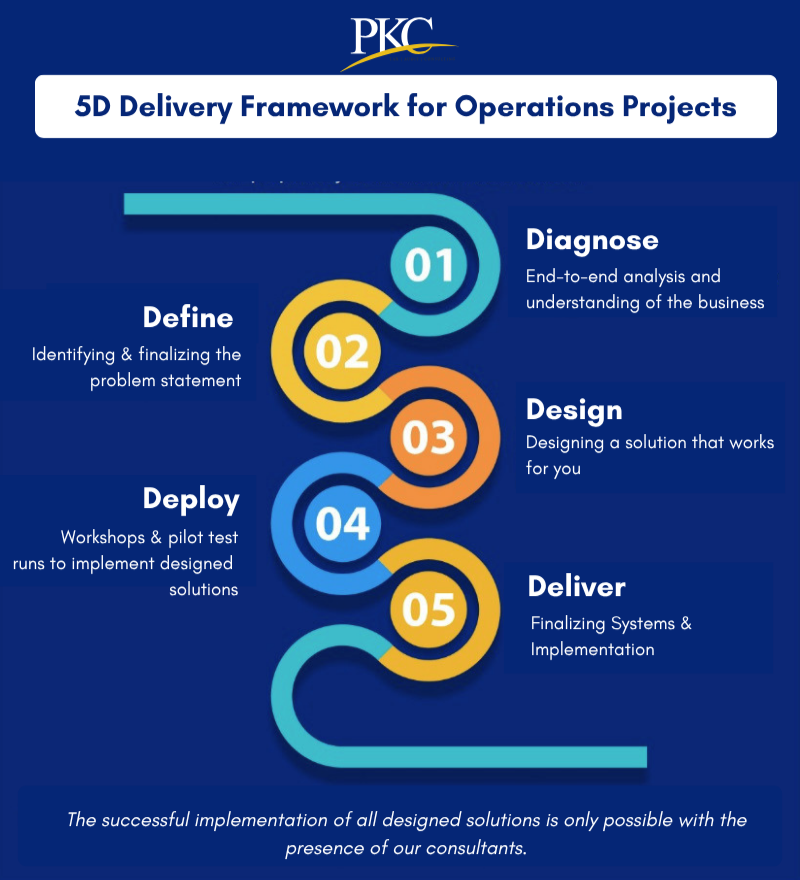
PKC’s 5D Delivery Framework for Operations Projects
Most consulting firms are good at diagnosis, but only a few can handle implementation.
PKC Management Consulting, uses a proprietary 5D framework to deliver operations projects. We ensure that every engagement moves from understanding to implementation in a disciplined, sequenced manner, with accountability at each stage.
Here’s how each phase works:
1. Diagnose
Every engagement begins with a deep, end-to-end analysis of the business: its systems, processes, people, and data flows.
Our consultants embed themselves into operations, observing how work actually happens across procurement, production, inventory, quality, logistics, and finance.
The goal is to build a precise picture of the current state before drawing conclusions. In India, where informal practices and undocumented workarounds are common, this phase often uncovers problems that don’t appear in management reports.
Output: Current state process and data analysis
2. Define
Once the current state is mapped, we identify and finalize the problem statement. Raw observations are converted into a structured definition: what’s broken, by how much, and what it’s costing the business.
Correct problem definition prevents the common pitfall of addressing symptoms instead of root causes.
For example, “high inventory costs” might actually result from poor demand forecasting combined with reliance on a single supplier. How the problem is framed shapes the entire intervention.
Output: Finalised problem statement and gap areas
3. Design
With the problem clearly defined, PKC designs a solution for your business problem. Solutions account for existing systems, available technology, workforce capabilities, and operational constraints.
PKC’s cross-functional expertise, spanning operations, finance, ERP systems, and process engineering, ensures that solutions are practical from the start, avoiding theoretically optimal but operationally unworkable designs.
Output: Customised solution blueprint
4. Deploy
Before full-scale rollout, we conduct structured workshops with the client team and run pilot tests of the solution. This phase, often skipped by other consultants, is crucial for success.
Workshops build understanding and buy-in, while pilot tests reveal real-world performance and allow adjustments.
The client team also gains hands-on experience, ensuring they can operate and maintain the new processes independently.
Output: Pilot-tested solution with trained internal team
5. Deliver
This is where we distinguish ourselves most clearly.
Rather than handing over a document and disengaging, consultants remain actively involved: finalizing systems, training employees, and embedding changes in daily operations.
At PKC, we emphasize, successful implementation requires consultant presence on the ground. This involvement turns designed solutions into actual operational improvements, rather than leaving recommendations to gather dust.
Output: Fully implemented and operational systems
The 5D framework addresses the most common failure in operations consulting: the gap between recommendations and reality. Each phase produces a clear, measurable output, making progress visible throughout the engagement.
For Indian businesses this structured approach ensures that operational changes stick, delivering improvements that are both practical and sustainable.
Typical Results — Cost Savings & Efficiency Gains
The results you can expect from a operation management consulting engagement can vary by starting point, industry, and scope of engagement.
A business with huge operational inefficiencies will see larger absolute gains than one that’s already reasonably well-run.
However, a well done engagement brings some consistent patterns that can be measured:
Cost Reduction
Direct cost savings are usually the most visible output. These can come from multiple sources such as:
Procurement and material: Vendor rationalisation, competitive sourcing, and improved payment terms can cut raw material costs by 5–15% without harming supplier relationships or quality. In India, where procurement is often relationship-driven, potential savings may be higher.
Inventory: Better demand planning and recalibrated safety stock can reduce raw material inventory from 60–90 days to 30–45 days, freeing significant working capital without increasing stockout risk.
Scrap and rework: Targeting root causes rather than end-of-line inspection can lower rejection rates, saving crores annually in materials and labor, alongside improved delivery quality.
Logistics and distribution: Route optimisation, freight benchmarking, and network redesign can cut freight costs by 10–20% through carrier consolidation and better load planning, especially in pan-India distribution.
Efficiency and Productivity Gains
Beyond direct cost savings, operations consulting boosts output from existing resources.
OEE (Overall Equipment Effectiveness): Many Indian plants operate with OEE values in the 40–55% range, indicating significant scope for improvement. Structured interventions like reducing unplanned downtime, speeding changeovers, and cutting speed losses, can raise OEE within 6–12 months, adding productive capacity without new capital.
Lead time reduction: Compressing order-to-delivery times lowers WIP inventory, accelerates cash conversion, and improves responsiveness. Reductions of 20–40% are achievable with redesigned planning and scheduling.
Labour productivity: Process standardisation, workplace organisation, and better scheduling cut idle time and redundant steps. Even a 10–15% improvement in labour-intensive Indian operations significantly lowers unit costs.
Benchmark Numbers Across Sectors
Here’s a look at some reasonable benchmarks observed across operations consulting engagements in Indian industrial and manufacturing businesses.
| Improvement Area | Typical Range |
| Procurement cost reduction | 5–15% |
| Inventory reduction | 20–35% |
| OEE improvement | 15–25 percentage points |
| Scrap and rework cost reduction | 30–60% |
| Lead time reduction | 20–40% |
| Logistics cost reduction | 10–20% |
| Labour productivity improvement | 10–20% |
When to Engage an Operations Consultant: 7 Signs You Must
You don’t need a consultant for every hiccup, some issues can be handled internally. But some signals imply your organization has outgrown its ability to fix problems on its own.
These signs indicate it’s time to bring in outside expertise:
⚠️ Inventory keeps climbing, but service levels don’t improve
Warehouses are overflowing with safety stock, yet customers still face late deliveries. This signals that planning processes are disconnected from reality.
A consultant can pinpoint whether the problem is forecast accuracy, supplier reliability, production scheduling, or all three, and implement systems that reduce inventory without hurting service.
⚠️ You are adding capacity instead of unlocking hidden capacity
Buying new machines, adding shifts, or leasing more space may seem necessary, but your existing assets might only be running at half efficiency.
If OEE hasn’t been measured recently, you likely have idle capacity. Consultants help you extract more from existing assets before committing capital.
⚠️ Quality problems keep coming back
Defects recur despite fixes, with the quality team focused on inspections and rework.
Rising chargebacks and warranty costs show that quality isn’t embedded in operations. Consultants apply root cause analysis and process controls to break this cycle permanently.
⚠️ Your supply chain is too complex, and no one owns the full picture
Multiple warehouses, suppliers, and logistics channels can create a fragmented system. Costs are spread across departments, and no one has end-to-end visibility.
Operations consultants provide an outside perspective to rationalize the network, consolidate where needed, and create the transparency to manage proactively.
⚠️ Your best people are stuck fighting fires
Plant managers chasing material shortages or supply heads handling angry customer calls are signs your leaders are trapped in daily crises.
Operations management consulting helps diagnose systemic issues systematically, freeing your team to focus on strategy and improvement.
⚠️ Previous improvement initiatives did not stick
Lean workshops, Six Sigma projects, or quality circles may have generated short-term results, but gains faded due to lack of follow-through, measurement, or leadership alignment
Consultants use structured frameworks, like PKC’s 5D Delivery Framework, to embed discipline and sustain improvements.
⚠️ Costs are rising faster than revenue
Margins shrink despite growing sales. Competitors maintain profitability, pointing to internal inefficiencies: waste, rework, underutilized labor, or logistics bleed.
Consultants conduct systematic cost analysis and implement controls to stop losses.
If two or more of these signs resonate, waiting only widens the gap with competitors.
Talk to PKC’s Operation Consultants today and get to the bottom of your bottomline