
 Expert verified
 Achieving operational excellence starts with clearly defined processes, and standard operating procedures (SOPs) help with that. SOPs ensure consistency, quality, and compliance while supporting risk reduction.
Understand with us the essentials of SOP, how to write an effective one, and the process we follow at PKC Management Consulting to implement the most effective SOPs.
.
What is SOP (Standard Operating Procedure)?
A standard operating procedure is a set of step-by-step instructions that describe how to carry out a routine task or procedure within an organization.
SOPs are designed to ensure that everyone in the organization follows the same process, resulting in minimal errors and inconsistencies. A key part of building effective SOPs is SOP and Process Mapping, which helps visualize workflows before they are documented.
SOP is used in a wide range of industries, including manufacturing, healthcare, IT, hospitality, and more.
A standard operating procedure can take different forms depending on the needs and requirements of a business. Here are some common forms of SOPs:
Common Types of Standard Operating Procedures
- Step-by-Step SOP: Provides a detailed, chronological sequence of steps that employees must follow to complete a task or process. Can include specific instructions, tools needed, and safety precautions.
- Hierarchical SOP: Breaks down a procedure into a series of sub-procedures, each with its own set of steps.
- Flowchart SOPs: Make use of graphical symbols and arrows to represent the sequence of steps involved in a process. They are easy to read and understand and are ideal for procedures that involve multiple paths and decision points.
Comprehensive Service Overview
PKC Management Consulting offers a full-spectrum SOP service that goes well beyond document creation. Our engagement covers every stage of the SOP lifecycle, from the initial consultation and process discovery phase all the way through to implementation, employee training, and ongoing monitoring.
Unlike firms that hand over a template and leave, PKC stays involved through the entire journey. We treat your operational processes as our own, ensuring that every SOP we build is practical, compliant, and genuinely adopted by your team rather than filed away and forgotten.
Here is a complete overview of what our SOP service covers:
Service Component | What It Covers |
|---|---|
SOP Consultation | Deep-dive analysis of your current workflows to identify process gaps and SOP requirements |
Process Mapping | Visual documentation of every key process with inputs, outputs, and decision points clearly mapped |
SOP Drafting | Custom-written SOPs in plain language, tailored to your team structure and operational context |
Compliance Integration | SOPs built to align with applicable Indian regulations, including GST, Companies Act, NABH, FSSAI, and RBI guidelines |
Employee Training | Structured onboarding and training sessions to ensure smooth adoption at every level of the organization |
Monitoring and Updates | Regular SOP reviews, compliance checks, and version updates as your business or regulatory environment changes |
Each of these components is delivered in a structured sequence so that nothing is rushed and no step is skipped. The result is a set of SOPs that your team actually uses, that hold up under regulatory scrutiny, and that continue to serve your business as it grows and evolves.
Who This Service Is For — Eligibility and Applicability
PKC’s SOP development and implementation service is designed for any Indian business that is serious about building an operational structure. Whether you are a first-generation entrepreneur formalizing processes for the first time or a mid-size company preparing for rapid expansion, SOPs are the foundation that makes sustainable growth possible.
You are the right fit for this service if your business is experiencing any of the following situations:
- Processes that depend on specific individuals rather than documented systems, creating operational risk when those people are unavailable
- Inconsistencies in quality, service delivery, or compliance across teams, shifts, or locations
- New employees taking too long to get up to speed because training is informal and undocumented
- Recurring errors or customer complaints that trace back to unclear or absent process guidelines
- Upcoming audits, certifications, or regulatory inspections that require formal process documentation
- A business that is scaling quickly and needs systems that can grow with it without breaking down
Here is a breakdown of the industries and business types we work with most frequently:
Industry | Best Suited For |
|---|---|
Manufacturing | Businesses facing quality inconsistencies, safety compliance gaps, or production inefficiencies |
Healthcare | Clinics, hospitals, and diagnostic centres needing NABH-aligned process documentation |
Retail and Distribution | Multi-store or franchise operations where consistency across locations is critical |
IT and Technology | Companies scaling their teams and needing repeatable onboarding and delivery processes |
Real Estate and Construction | Firms managing large project teams where handoff processes and documentation are weak |
Education | Institutions requiring UGC or NAAC-compliant operational and administrative procedures |
Hospitality | Hotels and restaurant chains are standardizing guest experience across properties |
SMEs and Startups | Growing businesses transitioning from founder-led operations to structured, team-run processes |
If your business falls outside these categories but you are dealing with process inconsistency or operational gaps, the principles of SOP design apply universally. PKC has worked with businesses across more than a dozen sectors and our methodology adapts to your specific operational context.
How to Write an Effective Standard Operating Procedure (SOP)?
SOP writing requires a well-planned approach. Here are our recommendations for writing the most effective SOP for business:
- Define Purpose, Scope, and Compliance Objectives
Clearly state the SOP’s goal and align it with organizational and regulatory requirements such as FSSAI for food safety or UGC for education. Specify departments, locations, or regional applicability, considering diverse state laws like labor laws. Integrate Indian legal frameworks such as GST, Companies Act 2013, and the Data Protection Bill, along with industry standards like NABH for healthcare.
- Involve Stakeholders with Cultural Sensitivity
Engage local managers and team leaders to address ground realities. Respect hierarchical structures by involving senior leadership for approvals, ensuring buy-in across the organization.
- Use Clear Language and Visual Aids
Make sure process documentation is in simple English. Also, provide regional language translations if needed, such as Tamil or Hindi. Include flowcharts, diagrams, or videos to aid comprehension, especially for multilingual or less literate workforces.
- Detail Step-by-Step Procedures
Break tasks into numbered steps, emphasizing safety in sectors like manufacturing. Balance SOP format standardization with flexibility for innovation where needed.
- Assign Roles with Accountability
Define responsibilities explicitly, clearly defining the escalation paths. Align with the company’s hierarchical culture, specifying authority levels.
- Incorporate Legal and Regional Requirements
Highlight industry-specific regulations such as RBI guidelines for banking and EPA for environmental compliance. Address state-specific variations wherever applicable.
- Plan Training and Implementation
Use hands-on workshops and digital tools such as mobile-friendly platforms for training. Leverage tech adoption via e-signatures and cloud-based SOP access.
- Establish Review and Update Mechanisms
Schedule quarterly or annual reviews to adapt to regulatory changes such as GST updates. Create feedback loops with employees to refine processes continuously.
- Pilot Testing and Feedback
Test SOPs in specific regions or teams to identify regional challenges. Use feedback to adjust for local practices like festival-related workflow changes.
- Formalize Approval and Documentation
Obtain sign-offs from authorized personnel such as HR Head or Plant Manager. Maintain audit-ready records, specifying formats like digital logs for tax compliance.
Why Choose PKC Management Consulting for SOP Development and Implementation?
An effective SOP requires following the proper standard operating procedures setup guidelines. Here are some of the reasons why experts at PKC can be your top choice:
Expertise and Comprehensive SOP Services
We have a team of highly skilled consultants with extensive experience in framing and executing a standard operating procedure.
We offer a full range of services, from initial consultation and analysis to SOP development, implementation, and training — all as part of our broader Management Consulting practice built over decades of industry experience.
Ensuring Consistency and Standardization in Business Processes
Successful implementation of SOPs with the help of expert providers like PKC can help in standardizing your processes and procedures and help improve consistency.
This ensures that everyone in your organization is following the same best practices.
Enhancing Quality and Customer Satisfaction Through Effective SOPs
Our standard operating procedures setup consultant helps you improve the quality of your products and services by implementing the best SOPs.
With your team working in a consistent and efficient manner, better outcomes and happier customers are guaranteed.
Boosting Efficiency and Productivity with Customized SOPs
Our SOPs are highly customized as per your needs.
They can help streamline your operations, eliminate unnecessary steps, and reduce the time and resources required to complete tasks. This leads to increased efficiency and productivity.
Achieving Compliance and Reducing Business Risks
Implementing an effective standard operating procedure with the help of our consultants can help reduce the risk of errors, accidents, and other issues that can impact your business.
Our experts stay updated on the changes in regulations and standards followed in your industry making sure you are always compliant.
Challenges in Adopting Standard Operating Procedure (SOP) and Solutions
Below are the key challenges faced by organizations in India in adopting SOP, with examples and solutions. For businesses where existing processes are deeply flawed rather than just undocumented, Business Process Re-engineering may be a necessary first step before SOP development can begin.
- Resistance to Hierarchical and Cultural Norms
Junior staff often hesitate to challenge processes, and sometimes improvisations override SOPs.
Example: Factory workers might skip safety checks to meet production targets quickly.
Solution: Involve employees at all levels in SOP design to foster ownership and reward compliance to shift cultural attitudes.
- Resource Constraints in SMEs and Rural Sectors
Small businesses and rural industries lack funds, infrastructure, or trained staff to adopt SOPs.
Example: A small agro-processing unit cannot afford digital tools for process documentation.
Solution: Start with low-cost paper-based SOPs and leverage government schemes to fund the transition.
- High Employee Turnover and Training Gaps
Frequent staff changes in sectors like manufacturing and hospitality disrupt SOP training continuity.
Example: A quick-service restaurant faces delays as new hires relearn food safety SOPs.
Solution: Simplify SOPs with pictograms and QR codes for quick access. You can also use micro-learning modules using platforms like WhatsApp.
- Inconsistent Implementation Across Regions
National companies face disparities in SOP adherence due to regional practices or infrastructure gaps.
Example: A hospital chain in one state follows sterilization SOPs, but a branch in another region lacks the required equipment.
Solution: Customize SOPs to regional realities and centralize monitoring with periodic audits.
- Technology Adoption Barriers
Uneven tech penetration limits digital SOP adoption.
Example: A rural healthcare center cannot access cloud-based SOP for healthcare manuals.
Solution: Use offline apps for SOP storage. Train staff via community radio or IVR systems in local languages.
6. Sector-Specific Challenges
Manufacturing businesses face the challenge of balancing productivity with safety SOPs under pressure.
Example: In healthcare, overburdened staff skip steps such as patient consent forms. In retail, franchisees ignore inventory SOPs to cut costs.
Solution: IoT sensors for automated compliance checks in manufacturing, AI-powered documentation tools in healthcare, and linking SOP compliance to incentives in retail.
Our Process and Methodology
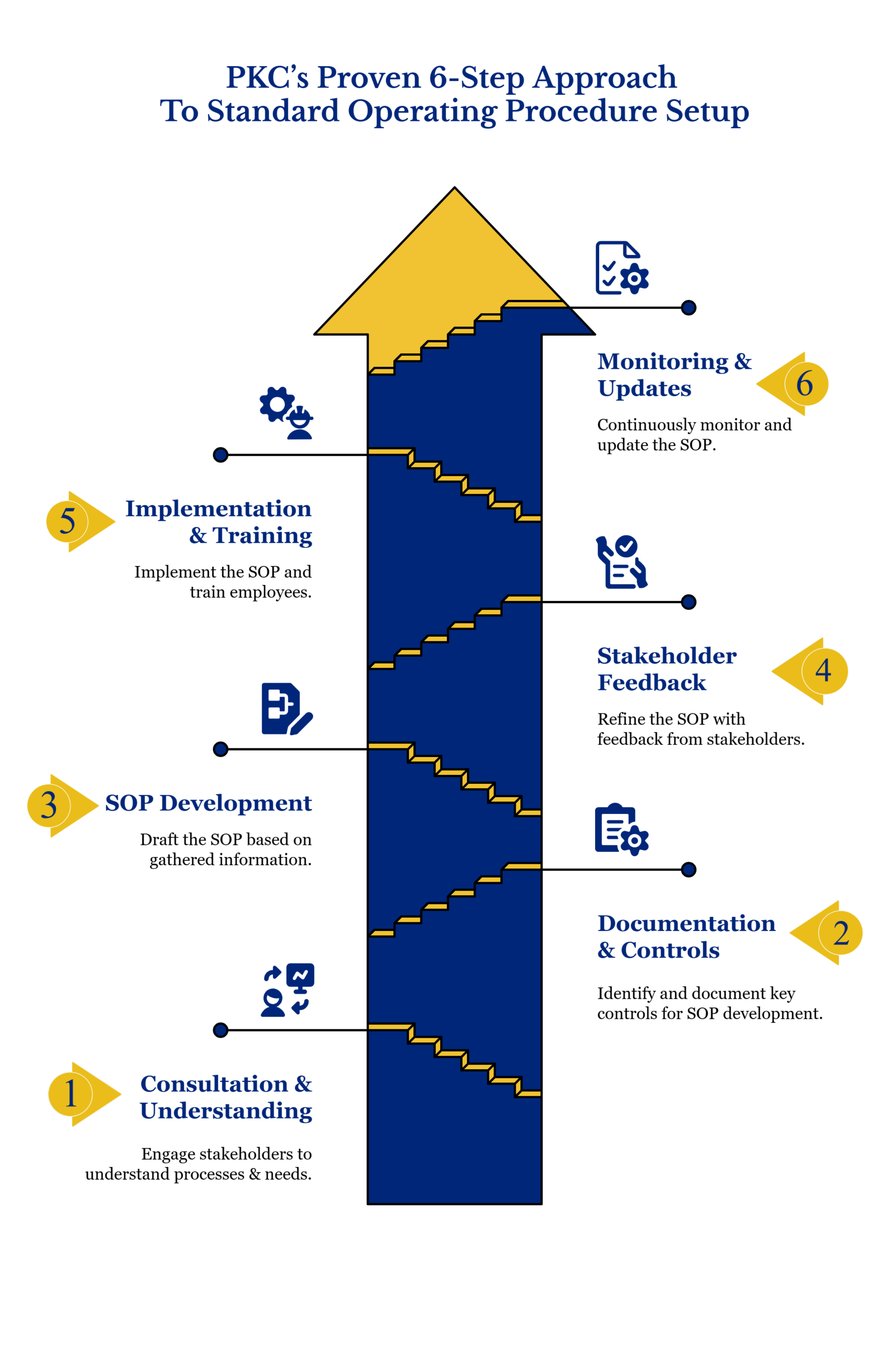
At PKC Management Consulting, we follow a structured six-step methodology that has been refined over 37 years of working with businesses across India. This approach ensures that every SOP we develop is not just technically sound but also genuinely embedded into your organisation’s daily operations.
Each step is designed to build on the previous one, creating a seamless progression from discovery to delivery. Here is how our process works:
Step 1: Consultation & Process Understanding
We begin every engagement by working closely with your leadership team and department heads to develop a thorough understanding of how your business operates today. This includes a detailed review of your existing workflows, pain points, team structures, and any regulatory requirements specific to your industry. The goal of this step is not to impose a framework but to listen carefully and map the reality of how your business actually functions on the ground. We identify the critical processes where SOPs will have the greatest impact and establish the baseline from which all documentation will be built.
Step 2: Documentation & Key Controls Identification
With a clear picture of your operations, we create a comprehensive process map for each area in scope. This map outlines every input, action, decision point, and output within the process. It serves as the blueprint for the SOP that follows.
At this stage, we also identify the key controls that need to be embedded into each process. These include defining which roles are responsible for which actions, setting measurable performance standards, establishing quality checkpoints, and flagging any compliance-critical steps that require particular attention.
Step 3: SOP Development & Drafting
Using the process maps and key controls as our foundation, we develop the full SOP documentation for each process. Every SOP is written in plain, direct language that any trained employee can understand without ambiguity.
We structure each document with numbered steps, clear role assignments, decision pathways, and escalation protocols where required. Visual aids such as flowcharts and decision trees are incorporated wherever they improve clarity. We also ensure that every SOP is formatted consistently across your organization so employees moving between departments or locations encounter a familiar structure.
Step 4: Stakeholder Feedback & SOP Refinement
Before any SOP is finalized, we share the draft documentation with your key stakeholders for review. This includes department managers, team leads, and, in many cases, the frontline employees who will be following the SOP daily.
We facilitate structured feedback sessions to surface any practical gaps, regional considerations, or workflow nuances that need to be addressed. All relevant feedback is incorporated into a revised draft, and the review cycle continues until every stakeholder is satisfied that the SOP accurately reflects how the process should and can realistically be executed.
Step 5: SOP Implementation & Employee Training
Approval of the SOP is the beginning of implementation, not the end of the process. PKC provides a structured training program designed to introduce the new SOPs to your workforce in a way that drives genuine adoption rather than surface-level compliance.
Training formats are tailored to your team’s profile and may include hands-on workshop sessions, visual reference guides, mobile-friendly digital formats, and supervised practice periods. We pay particular attention to ensuring that managers and team leaders are equipped to reinforce SOP adherence on an ongoing basis after the formal training period concludes.
Step 6: Ongoing Monitoring, Testing & SOP Updates
An SOP is only as valuable as its relevance to current operations. PKC provides ongoing monitoring support to ensure that the SOPs remain effective as your business evolves.
This includes scheduled compliance reviews, periodic testing of process adherence, and a clear update mechanism that triggers revision whenever a regulatory change, operational shift, or employee feedback warrants it. We also help you build internal audit capabilities so your team can manage SOP compliance independently over time, reducing dependence on external support while maintaining the discipline that effective SOPs require.
Get Expert Help with Your SOPs from PKC Management Consulting