 Expert verified
 Income tax notices for salaried employees are pretty common. While some notices are routine and easily manageable, others tend to be more serious.
Explore with us the reasons for these notices, what to do about them and also how to avoid these in the future in this simple guide.
11 Common Reasons Salaried Employees Get Income Tax Notices
Salaried employees can receive a tax notice for a number of reasons including:
1. ITR and AIS or Form 26AS Mismatch
This mismatch is fairly common and a frequent trigger for tax notices. Once you submit your ITR, the department compares the income you reported with:
- TDS reported by your employer (Form 24Q)
- Interest income reported by banks
- Dividend income reported by companies
- Investment and property transaction data
If the income you declared does not match with what appears in AIS (Annual Information Statement) or Form 26AS, the system flags it.
You may get a notice under section 143(1) for rectification.
2. Not Reporting Income from Multiple Employers
If you changed jobs during the financial year, you may have received income from two employers.
In this scenario, if you didn’t include salary from your previous employer, the system will detect the mismatch.
Reasons:
- Only reporting the latest Form 16
- Not clubbing income from both employers
- Underpayment of tax due to double basic exemption benefits
This can lead to a tax demand notice or interest under Sections 234B and 234C.
3. TDS Mismatch from Salary or Other Sources
Sometimes the income reported is correct, but the TDS claimed in the ITR does not match Form 26AS.
May happen if:
- Employer filed TDS return incorrectly
- TDS was deposited late
- You claimed excess TDS
- Typographical errors during filing
If the TDS credit does not reflect in Form 26AS, the department will not allow the claim and issue a demand notice under Section 156.
4. Non-Disclosure of Income from Other Sources
Many times salaried employees overlook other streams of income and miss reporting these:
- Interest earned on savings accounts, fixed deposits, or recurring deposits.
- Rental income from a property.
- Income from freelance work or a side business (even a very small one).
Since banks report the interest paid to you, the tax department will be aware of it. Failing to declare these incomes can result in IT notices.
Even small amounts are reflected in AIS and can trigger automated compliance checks.
5. High-Value Transactions
Banks, registrars, mutual fund houses, and other financial institutions report high-value transactions to the Income Tax Department.
This data is compiled in your AIS and Taxpayer Information Summary (TIS).
Common transactions that get flagged include:
- Large cash deposits (> ₹10 lakh)
- Credit card payments (> ₹10 lakh)
- Property purchase or sale (> ₹30 lakh)
- Mutual fund or share investments (>₹10 lakh)
If your reported income does not justify these transactions, the system may issue a notice under Section 142(1) or Section 148 for income escaping assessment.
6. Incorrect or Excess Deductions
Many salaried employees try to lower their tax liability by claiming deductions that they cannot prove or are not eligible for.
Following deductions are closely examined:
- Section 80C (LIC, PPF, ELSS, home loan principal)
- Section 80D (health insurance premium)
- Section 80TTA or 80TTB (savings interest)
- HRA exemption
- Section 80G (donations)
If you claim any of these or other eligible deductions without proof or exceed statutory limits, you may receive a defective return notice under Section 139(9) or inquiry under Section 142(1).
More recently, the Income Tax Department has issued “nudge” notices to high salary individuals that claim large donations to unrecognized political parties or suspicious charitable trusts.
7. Errors in House Property Income Reporting
If you own property, mistakes in reporting can lead to scrutiny. Common issues flagged include:
- Claiming property as self-occupied when it is rented
- Incorrect home loan interest deduction
- Miscalculation of rental income
- Not reporting deemed rent for second property
Home loan interest data is often reflected in AIS, which is cross-verified with your bank’s statement.
8. Failure to Report Capital Gains
Capital gains, whether short-term or long-term, have to be reported.
You must report:
- Sale of shares
- Mutual fund redemption
- Property sale
- Sale of cryptocurrency or digital assets
With SEBI and registrars reporting these transactions to the department, non-disclosure can lead to scrutiny under Section 143(2).
9. Non-Disclosure of Foreign Assets or Income
If you have worked abroad, earn foreign dividends, own foreign shares or RSUs (Stock Options), or have a foreign bank account, you must disclose them in Schedule FA.
Failure to report foreign assets is taken seriously under the Black Money Act and can lead to severe scrutiny.
10. No Response to Previous Notices or Queries
Sometimes, a notice is issued simply because you ignored a previous, simpler communication.
The department might have sent an intimation under Section 143(1) pointing out an arithmetical error.
If you do not file a rectification or respond within the given time, the initial demand can become final, or a more serious income tax scrutiny notice can be issued to investigate the matter thoroughly.
11. Random or Risk-Based Scrutiny Selection
And finally, not every notice means you’ve done something wrong.
Some returns are picked up for scrutiny under Section 143(2) through a risk-based or even random selection process by the Central Board of Direct Taxes (CBDT).
This is a standard part of how the department ensures compliance across the board.
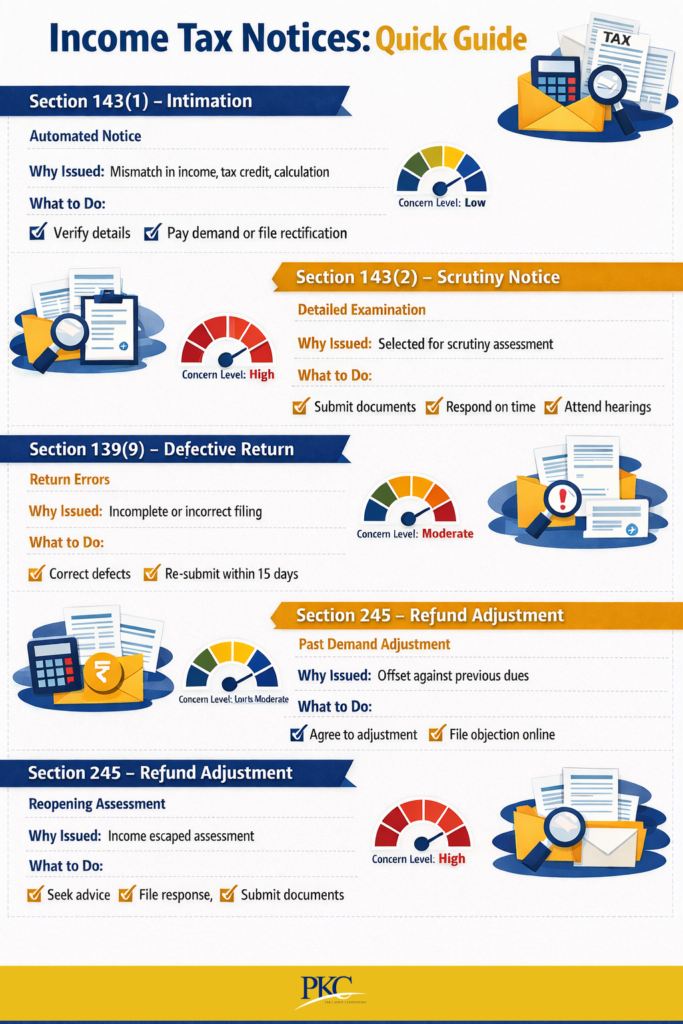
Types of IT Notices: Section 143(1), 148, 139(9), 245, 143(2) Explained
Each income tax notice a salaried person receives is issued under a specific section of the Income Tax Act, 1961, and serves a different purpose.
While some of these notices are routine system-generated intimations, others require you to seek professional tax advisory.
Here are the most common notices:
Section 143(1): Intimation After Processing
This is the most common and the least alarming communication issued by the department.
After you file your ITR, the department’s Centralised Processing Centre (CPC) in Bengaluru processes it. The system compares:
- Income declared in your ITR
- TDS reported in Form 26AS
- Information available in the AIS
- Tax calculations and deductions claimed
If the system finds any discrepancy like a tax mismatch, a calculation error, or a difference between your return and Form 26AS, it sends an intimation under Section 143(1).
Section 143(1) is not a scrutiny notice and can result in:
- A tax demand (if you’ve paid less than what’s due)
- A refund (if you’ve overpaid)
- Or a simple confirmation that your return has been accepted as filed
What To Do: Carefully review the intimation.
- If correct, pay the demand or wait for refund credit.
- If incorrect, file a rectification request under Section 154 (usually within 30 days) through the official e-filing portal
Time Limit: It is generally issued within 9 months from the end of the financial year in which the return is filed.
Section 139(9): Notice for a Defective Return
This notice is issued when your ITR is considered defective or incomplete. It means that the ITR cannot process your return in its current form.
It is procedural, not investigative.
Common Reasons:
- Filing the wrong ITR form
- Not reporting corresponding income for claimed TDS
- Incomplete tax payment details
- Not validating or verifying the return
- Non-disclosure of a required schedule
Example: Filing ITR-1 despite having capital gains from shares can trigger this notice.
What To Do: You are generally given 15 days to correct the mistake and file a valid return.
- File a revised or corrected return
- Ensure all missing details are properly updated
If you fail to do so, your original return is treated as if it was never filed. That can lead to late filing fees under Section 234F and loss of carry-forward benefits.
Section 245: Refund Adjustment Notice
You may receive this notice if you are expecting a refund but have unpaid tax demand from a previous year.
This is a pre-adjustment intimation, giving you a chance to respond. The department proposes to adjust your refund against the outstanding demand.
What To Do: Within the specified time (usually 30 days):
- Agree to the adjustment, or
- Disagree and provide supporting documents if the demand is incorrect or already paid
If you do not respond, it is treated as consent, and the refund will be adjusted automatically.
Make sure that before you accept, you have verified the old demand through your e-filing account.
Section 148: Income Escaping Assessment
This is a serious income tax notice for salaried employees. It is issued when the department suspects that you are under-reporting or non-reporting your income.
It is issued when the Assessing Officer (AO) has reason to believe that significant income has escaped assessment for a particular year.
Common Triggers:
- High-value property transactions
- Large cash deposits
- Significant stock market or crypto gains not disclosed
- Foreign assets or foreign income not reported
- Information received through AIS or other investigation channels
Time Limits: The department can reopen assessments up to 3 years from the end of the relevant assessment year in normal cases, and up to 10 years if the escaped income is ₹50 lakh or more.
Under the current framework, reassessment usually starts with a notice under Section 148A. This gives you a chance to respond before the case is formally reopened.
What To Do: Do NOT ignore this notice.
This is not a notice you can handle by yourself. It is best dealt with the help of experts. You may be required to:
- File a return for the relevant year
- Provide explanations and documentary evidence
- Justify reported income and deductions
Section 143(2): Scrutiny Notice
This is commonly known as the income tax scrutiny notice. Here the department wants to examine your return in greater detail.
It means your return has been selected for a thorough assessment, either through risk-based selection or CBDT’s scrutiny guidelines.
This doesn’t automatically mean you’ve evaded tax. However, it does require you to submit supporting documents, explanations, and records to substantiate what you’ve declared.
What to do: Respond within the stipulated time, submit all documents requested, and seek professional help to go through the process.
Time Limit: Must be served within 3 months from the end of the financial year in which the return was filed.
How to Verify If an Income Tax Notice Is Genuine
Before you respond to any income tax notice, share documents, or make a payment, first make sure to verify that the notice is authentic.
With scams becoming increasingly common and creative, the safest approach is to verify through official channels first, and respond later.
Quick Checklist to Verify a Genuine Income Tax Notice
| Checkpoint | Genuine Notice | Fake Notice |
| DIN Present | Yes | Usually No |
| Visible on e-Filing Portal | Yes | No |
| Official Email Domain | Yes | No |
| Proper Section Mentioned | Yes | Often Missing |
| Urgent Threatening Language | No | Yes |
Here’s how to go about it:
Checking The Notice on The Official Portal
Here’s how to confirm whether an income tax notice is genuine in India:
Step 1: Access the Official Website
Open a fresh browser window and manually type: https://www.incometax.gov.in
Avoid clicking on links provided in emails or SMS messages.
Step 2: Log in Using Your PAN
Use your PAN and password to log in securely.
Step 3: Check “Pending Actions” → “e-Proceedings”
This section displays:
- Active notices
- Intimations
- Scrutiny communications
- Reassessment proceedings
Every legitimate notice issued by the Income Tax Department is recorded on the official portal. If a notice has been genuinely issued in your name, it will be listed here with details and response options.
A notice received only via email, SMS, or post, without corresponding visibility on the portal is possibly a scam.
Step 4: Check “Services” → “e-Proceedings” or “View Notices/Orders”
You can also review previously issued communications under these sections.
If the notice is not visible in your dashboard, it is highly likely fraudulent.
What to Check on the Notice Itself
1. Verify DIN (Document Identification Number)
Since October 1, 2019, the CBDT has mandated that every official communication must carry a computer-generated DIN:
- It is a unique authenticity marker
- It can be independently verified
- A notice without a DIN is generally invalid, except in rare, recorded exceptions
On the homepage of the income tax portal, use the “Authenticate Notice/Order Issued by ITD” feature. You can verify using: DIN, or PAN, Assessment Year, and mobile number
If the portal shows no record found, the notice is most likely fake.
2. Correct Assessment Year & PAN
Ensure the PAN mentioned matches yours and that the assessment year aligns with your tax filings.
3. Section of the Income Tax Act
The notice should clearly state the section under which it is issued, such as:
- Section 143(1)
- Section 139(9)
- Section 148
- Section 245
Watch out for random references or missing section details.
4. Officer Details
A genuine notice will include:
- Name of the Assessing Officer
- Designation
- Official jurisdiction
5. Digital Signature
Electronic notices issued via the portal carry a valid digital signature.
Common Red Flags of Fake Income Tax Notices
- Demands payment to a personal bank account
- Shares a UPI ID or third-party payment link. All tax payments must be made only through the official portal or authorised banking channels.
- Threatens arrest or immediate legal action within hours
- Asks for OTP, net banking password, Aadhaar details, or card information. The Income Tax Department does not request banking credentials or OTPs.
- Comes from Gmail, Yahoo, or other non-government domains. Official communications typically come from domains such as: @incometax.gov.in or @tdscpc.gov.in
- Contains spelling errors, formatting inconsistencies, or unprofessional language
When Unsure, Use Official Support Channels
If you remain uncertain after checking the portal:
- Call Aaykar Sampark Kendra at 1800-103-0025 (toll-free)
- Visit your jurisdictional Assessing Officer
- Consult a qualified Chartered Accountant or tax advisor
Always use contact details published on the official portal, not numbers provided in suspicious emails.
Step-by-Step: Responding to an Income Tax Notice Online
Now that you’ve confirmed that the income tax notice is genuine, next, respond correctly and within the deadline.
Most income tax notices can be handled entirely online through the official e-filing portal without visiting a tax office.
Let’s see how you can do it:
Before You Start
Read the notice clearly and make sure you understand:
- Section under which the notice is issued
- Assessment Year involved
- Specific discrepancy or query raised
- Response deadline
Step 1: Log In and Locate the Notice
- Visit : https://www.incometax.gov.in. You can log in using PAN (User ID) and Password
- On the dashboard, go to the ‘Pending Actions’ tab and select ‘e-Proceedings’. This section lists all active notices issued to you, along with response deadlines and status.
- Click on the relevant Self-Assessment/Proceeding link to see the list of notices issued to you.
Step 2: Download and Analyze the Notice
- Click ‘View Notice’ to download the PDF.
- Download the PDF copy and review it carefully. Clarity at this stage prevents incorrect submissions.
- Identify the Section applicable such as 143(1) (Intimation), 139(9) (Defective), or 245 (Refund adjustment)
- Look for the specific “Reason” or “Discrepancy” mentioned. This is usually presented in a table comparing “As provided by Taxpayer” vs. “As computed by the Department.”
Step 3: Gather Supporting Documents
Prepare all the relevant documents related to the issue raised. Some of the documents, you may need include:
- Form 16 or Form 16A
- Form 26AS
- Annual Information Statement (AIS)
- Bank statements
- Investment proofs under Section 80C, 80D
- Rent receipts and landlord PAN for HRA
- Capital gains statements from brokers or mutual funds
- Home loan interest certificate
Make sure that the files are in a clear and readable PDF format(usually under 5MB per file)
Organise your documents in a logical order before uploading.
Step 4: Choose the Correct Response Option
Click “Submit Response” under the relevant notice.
Depending on the notice, you may see options:
- Agree with demand
- Partially agree
- Disagree
- Submit revised return
- File rectification
| If You Agree | If You Disagree |
| Accept the discrepancyPay tax using the “e-Pay Tax” optionSubmit challan detailsE-verify if required | Provide a clear factual explanationUpload supporting documentsAvoid emotional languageAddress each point separately |
Step 5: Verify the Submission
A response is not considered valid unless verified.
- After uploading documents and remarks, click “Submit”
- Complete e-verification using Aadhaar OTP, net banking, or Digital Signature Certificate
- Once submitted, download the acknowledgement receipt and save a copy digitally.
Also, keep backup records. This serves as proof that you responded within the deadline.
IMPORTANT: Although the online process is simple, in order to respond accurately, you need to clearly understand tax laws.
If the issue is complex, involves large amounts, or is an income tax scrutiny notice, consider seeking expert help. A professional can draft a strong response and ensure you don’t unintentionally admit liability.
Response Deadlines & Penalties for Non-Compliance
| Notice Type | Response Time | Risk If Missed |
| Section 139(9) | 15 days | Return treated as invalid |
| Section 143(1) | 30 days | Demand becomes final |
| Section 245 | 30 days | Refund automatically adjusted |
| Section 148 / 143(2) | As specified | Assessment may proceed ex parte |
TDS Mismatch: The #1 Trigger for Salaried Employee Notices
Most intimations under Section 143(1) arise when the TDS claimed in your ITR does not match the Income Tax Department’s records.
The system is automated. It compares your return with data reported by employers, banks, and other deductors. Even small discrepancies can trigger a notice.
TDS is simple in principle:
- Your employer deducts tax from your salary each month
- Banks deduct TDS on FD interest beyond threshold limits
- Clients deduct TDS on professional or consulting payments
- The deducted tax is deposited with the government against your PAN
- These deductions appear in Form 26AS, AIS, and TIS.
When you file your ITR, you claim credit for this TDS. The department’s system checks if your claim matches the amount actually deposited.
If the numbers don’t match, a notice is generated.
Reasons for TDS Mismatch
TDS mismatches happen because of data inconsistency, but the reasons vary. Some of the most common scenarios are:
| Scenario | Issue | Fix |
| Multiple employers | Income underreported | File revised return |
| FD interest ignored | Income not declared | Report under Other Sources |
| Wrong PAN by employer | TDS not credited | Employer to correct TDS |
| TDS not in 26AS | Excess credit claimed | Revise return / Pay demand |
| Tenant TDS not filed | Credit not reflecting | Tenant to file TDS return |
1. Salary Mismatch Between Employer Reporting and ITR
Employers file quarterly TDS returns (Form 24Q) showing salary paid and TDS deducted
This data flows into Form 26AS.
Common errors include:
- Forgetting to include salary from a previous employer
- Missing bonus or incentive components
- Entering incorrect salary figures
- Claiming TDS as per salary slips instead of Form 26AS
If salary income or TDS claimed in your ITR differs from what your employer reported, the system immediately flags it.
2. Ignoring TDS on Non-Salary Income
Many salaried employees focus only on salary and overlook other income sources.
Examples:
- Bank Fixed Deposits: Banks deduct TDS if interest exceeds ₹50,000 (₹1,00,000 for senior citizens). This reflects in Form 26AS. If you claim TDS but do not report the interest income, a mismatch arises.
- Freelance or Consulting Income: If TDS is deducted under Section 194J or 194C and appears in Form 26AS, the related income must be declared.
- Rental Income: If a tenant deducts TDS under Section 194-IB, it will show in your tax credit statement. The rental income must also be reported.
The department already sees this income in its system. If your return does not reflect it, the discrepancy is automatic.
3. Multiple Employers in One Financial Year
If you switched jobs, you must include income from all employers and TDS from both must be aggregated.
If you omit the previous employer’s income, it causes underreporting and mismatch.
4. Employer or Bank Filing Errors
Sometimes the issue is not created from your end, like:
- Incorrect PAN quoted by deductor
- TDS deducted but not deposited
- Delayed filing of TDS return
- Wrong assessment year mentioned
In such cases, the TDS will not reflect in Form 26AS, even though it appears in your salary slip or Form 16.
5. Timing Differences
Occasionally TDS deducted in March is deposited in April. It reflects in the following assessment year
If you claim credit prematurely, mismatch arises.
How a TDS Mismatch Notice Looks
For TDS mismatches, you will usually receive an intimation under Section 143(1).
The notice shows:
- Income declared by you
- Income computed by the department
- TDS claimed by you
- TDS allowed as per Form 26AS
- Resulting tax demand or refund
Often, the adjustment is simply the disallowance of excess TDS claimed.
How to Avoid Future Income Tax Notices
Most notices to salaried taxpayers arise from predictable issues and can be avoided:
1. Reconcile Before You File
Before filing your return, review Form 26AS, AIS and TIS. Also:
- Match salary with Form 16
- Match TDS exactly with Form 26AS
- Review AIS for interest, dividends, capital gains, property deals, or high-value spends
- Ensure every reported income item is declared or correctly shown as exempt
2. Declare All Income
Report all income. This means even small amounts such as savings interest, dividends, minor capital gains, or freelance receipts. The system can flag even the smallest amount.
If income is exempt, report it under the exempt schedule instead of omitting it.
3. Use Correct ITR Form & File on Time
Filing the wrong form can trigger a defective return notice under Section 139(9).
- ITR-1: Only for simple salary cases without capital gains
- Capital gains, foreign assets, or multiple properties require other forms
Timely filing helps you avoid late fees. carry forward eligible losses and reduce procedural complications. The consistency also strengthens your compliance profile.
4. Claim Deductions Within Limits
Deductions under Chapter VI-A are legal tax-saving tools, but must be accurate. Always assume that deductions may be reviewed later.
Claiming more than the permitted cap invites adjustments.
5. Monitor TDS Throughout the Year
Since TDS mismatches are the most common trigger:
- Check Form 26AS quarterly
- Verify employer and bank TDS credits
- Ensure your PAN is correctly quoted
- Follow up immediately for missing entries
Do not wait until filing season.
6. Maintain Organized Records
Keep records for at least 6 years from the relevant assessment year. Well-organized digital storage is sufficient.
Maintain copies of:
- ITR acknowledgements
- Form 16
- Investment proofs
- Bank statements
- Capital gains reports
- Property documents
7. Use AIS Feedback
If AIS shows incorrect or duplicate entries, submit feedback on the portal before filing.
Correcting data early reduces mismatch risk.
8. Double-Check Technical Details
Clerical errors can also trigger notices.
Verify: PAN–Aadhaar linkage, Bank account and IFSC details, Correct assessment year and Contact information
When to Consult a Tax Professional for IT Notices
You don’t need a tax professional for simple notices under Section 143(1), small TDS mismatches, or minor corrections online if the issue is clear.
But some notices involve legal or financial risks and that’s when external support is crucial:
1. Scrutiny Notice (Section 143(2)): This means your return is selected for detailed examination by an AO.
It may involve:
- Large deductions
- Capital gains
- High-value investments
- Income mismatches
Why Experts: Scrutiny requires structured replies and strong documentation. Poorly drafted responses can lead to avoidable additions to income.
2. Reassessment Notice (Section 148): This is a serious notice and can reopen completed assessments.
The notice means that the department believes income has escaped assessment for a past year.
Why Experts: You may need to assess the validity of the notice, file a return again, and present legal arguments. Errors here can y increase your tax exposure.
3. Large Tax Demands: If the notice shows a huge tax demand, review it carefully before responding.
Why Experts: Large demands require strategy, not reactive compliance. A professional can:
- Reconcile department calculations
- Identify AIS/Form 26AS errors
- Advise on rectification, revision, or appeal
4. Complex Transactions: Complex positions need proper documentation and clear explanation. Get help if your return includes:
- Capital gains (shares, property, mutual funds)
- Cryptocurrency
- Business or freelance income
- Rental income
- Foreign income or assets
5. Penalty Proceedings (Section 270A): Penalties for underreporting (50%) or misreporting (200%) depend on how the issue is presented.
Professional guidance can help argue genuine error and reduce penalty exposure.
6. Missed Deadlines or Escalation: If you receive:
- Best judgment assessment (Section 144)
- Recovery proceedings
- Attachment or garnishee action
Immediate expert intervention is advisable. Remedies are time-sensitive.
7. Foreign Assets or Global Income: Foreign bank accounts, RSUs, overseas property, or remittances attract stricter reporting rules. Non-disclosure can lead to severe penalties, even if tax is minimal.
The PKC Management Consulting Advantage
With 37+ years of expertise and dedicated Tax Advisory services, PKC India has handled thousands of income tax notices—from routine intimations to complex scrutiny, search, and appeals.
We understand the tax department’s approach, legal nuances, and the value of timely compliance.
You don’t have to face the tax department alone. Whether simple or complex, our experts provide the clarity, protection, and peace of mind you need.*