

 Expert verified
 Income tax and auditing are key responsibilities for businesses and professionals under the Income Tax Act. Here, a CA reviews financial records to ensure accuracy and compliance, helping protect both taxpayers and the revenue department.
Learn all about tax auditing in this guide. We explain tax audit applicability, how the process works, and how you can make it smoother.
What Is an Income Tax Audit (Section 44AB)?
An Income Tax Audit under Section 44AB of the Income Tax Act, 1961 is a statutory review of a taxpayer’s financial records conducted by a Chartered Accountant (CA).
The main purpose of a tax audit is to verify that the income, expenses, deductions, and tax obligations reported in your income tax return (ITR) are accurate.
It is a mandatory compliance requirement triggered once a taxpayer crosses specific turnover or gross receipt thresholds.
Purpose of the Income Tax Audit
1. Strengthen tax compliance
A tax audit reduces the possibility of income being underreported or deductions being exaggerated. It creates a proper layer of accountability.
2. Improve transparency in financial reporting
For taxpayers, it promotes better record-keeping and financial discipline. Many businesses discover accounting errors, incorrect expense claims, or missed compliance requirements during the audit process itself.
3. Support efficient tax administration
Because a CA has already reviewed the accounts, the tax department can rely on the audit report they provide instead of conducting detailed checks on every return.
Scope of Tax Audit
During a tax audit, the auditor evaluates several aspects of a taxpayer’s financial and compliance records, including:
Books of accounts: The auditor verifies whether proper books have been maintained as required under Section 44AA of the Income Tax Act.
Method of accounting: Businesses must follow a consistent accounting method such as the mercantile system or cash system. The auditor checks whether the chosen method has been applied correctly.
Income computation: The CA confirms that income from business or profession has been calculated correctly and reported accurately in the return.
Deductions and expenses: The audit verifies whether deductions claimed under various provisions are legitimate and supported by documentation.
TDS compliance: The auditor examines whether Tax Deducted at Source (TDS) has been properly deducted and deposited where applicable.
Significant financial transactions: Certain transactions that attract tax implications are reviewed carefully. These include loans, depreciation claims, related-party transactions, capital gains, and payments above prescribed limits.
Presumptive taxation checks: If a taxpayer uses presumptive taxation schemes such as Sections 44AD, 44ADA, or 44AE, the auditor verifies whether the scheme has been applied correctly or whether audit requirements are triggered.
The findings of the tax audit are documented using specific forms (3CA, 3CB and 3CD) prescribed under the Income Tax Rules.
Who Can Conduct a Tax Audit?
Only a practising Chartered Accountant holding a valid Certificate of Practice issued by the Institute of Chartered Accountants of India can perform a tax audit under Section 44AB.
A CA who is employed by a company cannot sign a tax audit report. She/he must be in independent professional practice.
To maintain audit quality and ensure adequate diligence, a CA is allowed to undertake a maximum of 60 tax audit assignments per financial year
Given the technical nature of tax audits and the compliance requirements it’s best to seek professional tax advisory support.
Firms such as PKC Management Consulting assist you with documentation, compliance, and coordination, helping reduce errors and penalties.
Who Needs a Tax Audit: Turnover & Income Thresholds
Many taxpayers assume that tax audits apply only to large companies or only when a business makes huge profits.
But, the tax audit applicability is primarily based on turnover, gross receipts, and how income is declared, not on profitability.
Here’s a quick tax audit applicability table:
| Taxpayer Category | Condition | Threshold |
| Business (general) | Turnover exceeds limit | ₹1 crore |
| Business (digital transactions ≤5% cash) | Turnover exceeds limit | ₹10 crore |
| Professionals | Gross receipts exceed limit | ₹50 lakh |
| Section 44AD (business presumptive scheme) | Income declared below 6% or 8% and total income exceeds exemption limit | Up to ₹3 crore turnover for digital businesses or ₹2 crore otherwise |
| Section 44ADA (professional presumptive scheme) | Income declared below 50% and total income exceeds exemption limit | Up to ₹75 lakh receipts |
| Section 44AE (transport business) | Income declared below prescribed rate | Per vehicle basis |
Tax Audit for Business Owners
For most businesses, the primary trigger for a tax audit is turnover.
Businesses With Total Turnover > ₹1 Crore
Under Section 44AB(a), a tax audit becomes mandatory for businesses if the total sales, turnover, or gross receipts exceed ₹1 crore in a financial year.
The threshold is based on gross turnover, which means that if a trading business records sales of ₹1.5 crore but ends the year with a loss, they will still need an audit.
The audit applies regardless of the type of entity, including:
- Sole proprietorships
- Partnership firms
- Limited Liability Partnerships (LLPs)
- Companies
The rule also applies across industries, whether the business is engaged in trading, manufacturing, or service activities.
Digital Dominant Businesses: ₹10 Crore Threshold
To encourage digital payments and reduce cash-based transactions, a higher audit threshold was introduced for businesses with minimal cash dealings.
If a business meets the following conditions, then the tax audit threshold increases from ₹1 crore to ₹10 crore.:
- Cash receipts do not exceed 5 percent of total receipts, and
- Cash payments do not exceed 5 percent of total payments
Example: An e-commerce seller with ₹6 crore turnover, receiving almost all payments via online gateways or bank transfers, may not need a tax audit until turnover exceeds ₹10 crore, since cash transactions stay within the 5% limit.
The calculation is based on transactions throughout the entire financial year. So businesses should track payment modes consistently rather than reviewing them only at year-end.
Tax Audit for Professionals
For professionals, the audit threshold is different.
Professionals: ₹50 Lakh Gross Receipts Limit
Under Section 44AB(b), professionals must undergo a tax audit if gross receipts exceed ₹50 lakh in a financial year.
This applies to individuals who are in professions specified under Section 44AA, including:
- Doctors and medical practitioners
- Lawyers and legal consultants
- Chartered accountants and tax consultants
- Architects and engineers
- Technical consultants
- Interior designers
For professionals, the term gross receipts includes all fees and professional income received during the year before deducting expenses.
Example: If a consultant earns ₹55 lakh in professional fees during the financial year, a tax audit becomes mandatory regardless of the net profit earned.
Presumptive Taxation & Tax Audit Applicability
Presumptive taxation schemes were introduced to simplify compliance for small taxpayers.
However, choosing to declare income differently from the prescribed rates can trigger a tax audit requirement.
Section 44AD: Small Businesses
Under Section 44AD, eligible businesses with turnover up to ₹3 crore (if cash receipts ≤5% of total), or up to ₹2 crore can declare income at these presumed rate:
- 8% of turnover for cash receipts
- 6% of turnover for digital receipts (cheque, bank transfer, electronic modes)
Note: The 6% / 8% applies proportionally to the actual mix of cash vs digital receipts in the turnover.
If income is declared at or above these rates, taxpayers are generally not required to maintain detailed books or undergo a tax audit.
Example: If a business with ₹1.5 crore turnover declares only 4 percent profit instead of the presumptive rate, it must undergo a tax audit.
Another important aspect is the 5-year rule.
If you opt out of the presumptive scheme after using it, you cannot return to it for the next five years and may need to maintain books and undergo audits depending on income levels.
Section 44ADA: Professionals
For professionals, Section 44ADA allows presumptive taxation if gross receipts do not exceed ₹75 lakh.
Under this scheme, professionals can declare 50 percent of their gross receipts as income, and detailed bookkeeping is not mandatory.
However, if a professional declares income lower than 50 percent of gross receipts and total income exceeds the exemption limit, a tax audit becomes mandatory.
Section 44AE: Goods Carriage Operators
Transport operators engaged in the business of plying, hiring, or leasing goods vehicles can opt for presumptive taxation under Section 44AE. Income is calculated on a fixed amount per vehicle.
If the taxpayer declares income lower than the prescribed presumptive amount, a tax audit may be required.
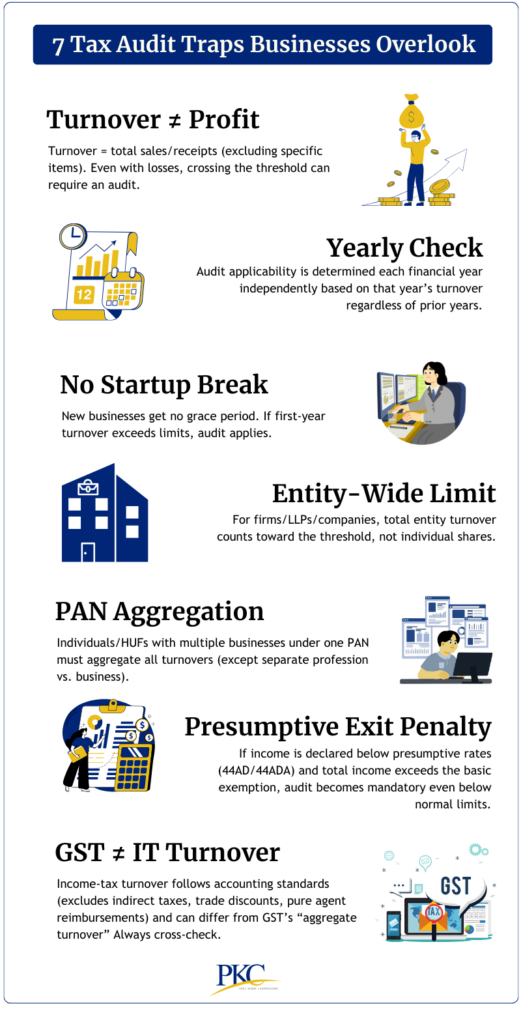
Tax Audit Limits for FY 2026-27 (Updated)
For Financial Year 2026–27, the turnover thresholds for tax audit applicability under Section 44AB are unchanged (₹1/10 Cr business, ₹50L profession)
Businesses and professionals should continue to follow the same limits as stated above.
However, a few procedural and compliance updates were introduced around Budget 2026 and thesemay affect how tax audits are conducted and enforced.
Budget 2026 Update: Penalty Reclassified as Fee
What changes this year is the treatment of charges for failing to complete a tax audit on time.
Earlier, non-compliance led to a penalty under Section 271B of the Income Tax Act, calculated as:
0.5% of total turnover or gross receipts, or ₹1,50,000, whichever is lower
Following updates proposed in Budget 2026, this amount is now classified as a fee rather than a penalty.
Although the financial exposure remains exactly the same, the change has an administrative impact. Fees are usually easier for the tax authorities to levy and collect compared with penalties, which often involve disputes or appeals.
The intention behind this action is to reduce litigation and simplify enforcement.
As a taxpayer, you must still complete a tax audit and submit the audit report within the due date. If not, the financial consequence of missing the deadline is still applicable.
ICAI Guidelines on Chartered Accountant Audit Limits
Another development relevant for FY 2026–27 concerns the number of tax audit assignments a CAs can undertake.
ICAI still limits each member to 60 tax audit reports per year, and the new guidance explains how this limit works when CAs are part of a firm:
- The limit of 60 audits applies to each individual CA, even if they are part of a partnership firm.
- Audit assignments cannot be redistributed among partners simply to bypass the cap.
- Revised tax audit reports are generally excluded from the count.
- Certain cases relating to presumptive taxation schemes such as Sections 44AD, 44ADA, and 44AE are not counted toward the 60-audit ceiling.
Form 3CA vs 3CB vs 3CD: Which Form Applies?
When a tax audit under Section 44AB is conducted, the CA must report the audit findings through prescribed audit report forms. These are filed electronically.
There are three forms that work together:
- Form 3CA: Audit report when accounts are already audited under another law
- Form 3CB: Audit report when no other statutory audit exists
- Form 3CD: Detailed statement of particulars that accompanies both reports
Form 3CA: When Another Law Already Requires an Audit
Form 3CA is used when the taxpayer’s financial statements are already audited under another applicable law.
In these cases, the income tax law does not require a completely separate audit of the same books. Instead, the CA references the existing statutory audit and provides a tax-specific certification.
Example: A company audited under the Companies Act, 2013 is legally required to undergo a statutory audit of its financial statements each year. When such a company crosses the turnover threshold for a tax audit, the CA files Form 3CA along with Form 3CD.
Entities that use Form 3CA:
- Companies audited under the Companies Act
- Cooperative societies audited under state cooperative society laws
- Banking institutions audited under the Banking Regulation Act
- Insurance companies governed by the Insurance Act
- Certain regulatory bodies where audits are mandated by statute
In Form 3CA, the CA certifies that:
- Accounts have already been audited under another law
- Audit report and financial statements from that audit are attached
- Tax audit disclosures in Form 3CD are based on those audited accounts
Important: The statutory audit must be completed before the tax audit report is filed. If it hasn’t been completed, Form 3CA cannot be used.
Form 3CB: When No Other Audit Is Required
Form 3CB applies when the taxpayer is not subject to any statutory audit under another law.
Here, the tax audit under Section 44AB becomes the primary and independent audit of the books of accounts.
The CA must examine the financial statements and provide a full audit opinion specifically for tax purposes.
Entities commonly filing Form 3CB:
- Sole proprietorship businesses
- Individuals with business or professional income
- Hindu Undivided Families (HUFs) engaged in business
- Partnership firms not otherwise audited under another law
- LLPs that do not cross the statutory audit limits under the LLP Act
In this form, the CA confirms that:
- Books of accounts have been independently examined
- Financial statements agree with the books maintained
- Relevant accounting standards and tax provisions have been considered
- The information reported in Form 3CD is accurate
Because there is no prior statutory audit to rely on, Form 3CB requires a more comprehensive declaration by the auditor.
Form 3CD: The Detailed Statement of Particulars
Regardless of whether Form 3CA or Form 3CB is used, Form 3CD must always be filed alongside the audit report.
Form 3CD is the most detailed component of the tax audit process. It contains an extensive set of disclosures about the taxpayer’s financial position, accounting practices, and tax compliance.
Currently, Form 3CD includes 44 reporting clauses, each covering specific areas that may affect the taxpayer’s tax liability.
Some key disclosures include:
| Clause Area | Information Reported |
| Method of accounting | Cash or mercantile system and any changes during the year |
| Books of accounts | Nature and location of books maintained |
| Depreciation | Block-wise asset details and depreciation claims |
| TDS compliance | Whether tax was deducted and deposited where required |
| Loans and deposits | Cash transactions exceeding limits under Sections 269SS and 269T |
| Related party payments | Transactions with relatives or associated entities |
| Deductions claimed | Details under sections such as 80G, 35D, etc. |
| MSME payments | Outstanding dues to micro and small enterprises |
| Speculative transactions | Details of speculative business income or loss |
| Property income disclosures | Certain reporting related to rent and arrears |
These disclosures help tax authorities verify whether the taxpayer has complied with key provisions of the Income Tax Act.
Completing Form 3CD requires careful reconciliation of financial records, bank statements, tax deductions, and statutory filings. It is not a simple checklist but a detailed reporting exercise requiring professional judgment.
Examples of how The Forms Work Together
Example 1: Company with Statutory Audit
A private limited company has a turnover of ₹4 crore and undergoes a statutory audit under the Companies Act.
- The CA files Form 3CA, referencing the statutory audit
- Form 3CD is attached with detailed tax disclosures
Form 3CA + 3CD → uploaded together on the income tax portal
Example 2: Partnership Firm without Statutory Audit
A consulting partnership firm has gross receipts of ₹80 lakh and is not required to undergo any audit under other laws.
- The CA performs an independent audit
- Form 3CB is filed as the audit report
- Form 3CD provides the detailed disclosures
Form 3CB + 3CD → Both forms filed together
After submission, the taxpayer must log in to the income tax portal and accept the audit report.
The audit is not considered filed until the taxpayer completes this acceptance step.
Can a Tax Audit Report Be Revised?
If an error or omission is discovered after filing the tax audit report, the auditor may submit a revised tax audit report.
Revisions are permitted when:
- Errors are discovered in previously reported information
- Additional facts come to light after filing
- Legal interpretations or provisions change
The revised report must be filed before the due date for filing the income tax return, or supported by a valid reason for the correction.
Tax Audit Due Date & Extension Rules
The tax audit deadline is one of the most critical compliance dates in a taxpayer’s income tax calendar.
Missing it can trigger financial consequences and may also delay your ITR filing.
Statutory Tax Audit Due Dates
For taxpayers who need a mandatory tax audit, the standard timeline is:
| Taxpayer Category | Tax Audit Report Due Date | ITR Filing Due Date |
| General tax audit cases | 30 September of the AY | 31 October of the AY |
| Transfer pricing cases | 31 October of the AY | 30 November of the AY |
For example, if the audit relates to FY 2025–26 (AY 2026–27):
- Tax audit report must be filed by 30 Sep 2026
- Income tax return must be filed by 31 Oct 2026
Link Between the Audit Report and the ITR
The tax audit report and the income tax return are legally interconnected. The filing process has three sequential steps:
- CA prepares and uploads the tax audit report on the e-filing portal.
- Taxpayer logs in and accepts the audit report.
- Taxpayer files the ITR referencing that audit report.
If the audit report is not uploaded or accepted before filing the return, the system will reject the ITR submission with an error indicating that the audit report is missing.
A return filed without the required audit report may be treated as a defective return under Section 139(9), which requires correction within a prescribed time limit.
Extensions for Tax Audit
The authority to extend income tax deadlines lies with the Central Board of Direct Taxes (CBDT) under Section 119 of the Income Tax Act,.
Extensions are usually granted in cases such as:
- Natural disasters affecting business activity
- Technical issues with the income tax portal
- Delays in releasing income tax return utilities
- Major legislative changes affecting compliance
- Representations from professional bodies such as chartered accountant associations
Note: These extensions are not guaranteed and are issued only when the government considers the circumstances exceptional.
Therefore, we recommend businesses to plan around the original statutory deadlines rather than expecting an extension.
Timeline for Completing a Tax Audit
To avoid last-minute compliance issues, most businesses follow a structured audit preparation schedule.
| Time Period | Task |
| April to June | Finalize books of accounts for the previous financial year and reconcile bank statements. |
| July | Engage the Chartered Accountant and share accounting records, GST data, and supporting documents. |
| August | Complete audit procedures, resolve queries, and review Form 3CD disclosures. |
| Early September | CA uploads the audit report and the taxpayer accepts it on the portal. |
| 30 September | Statutory tax audit deadline is met comfortably. |
Penalties for Non-Compliance (Section 271B)
Section 271B applies when a taxpayer who is required to comply with Section 44AB:
- Fails to get their accounts audited, or
- Fails to furnish the tax audit report (Form 3CA or Form 3CB along with Form 3CD) by the specified due date.
In such cases, they have to bear a monetary penalty. Its amount is calculated as the lower of the following two values:
- 0.5% of total sales, turnover, or gross receipts, or
- ₹1,50,000
Example: If a business has a turnover of ₹2 crore, the calculation works as follows:
0.5% of ₹2 crore = ₹1,00,000 and Maximum limit = ₹1,50,000
Since ₹1,00,000 is lower than the cap, the payable amount would be ₹1,00,000.
The provision applies regardless of whether the taxpayer is an individual, partnership firm, LLP, or company.
As noted above, Budget 2026 reclassifies the charge under Section 271B. Earlier treated as a penalty for failing to conduct a tax audit, it is now classified as a fee. The amount is unchanged.
This was done to reduce litigation arising from technical procedural challenges to penalty proceedings.
For taxpayers, this means that they can’t rely only on procedural arguments anymore; they need stronger, substantive defenses like proving a reasonable cause, to challenge the levy.
Section 273B: The “Reasonable Cause” Defence
While the provision imposes a monetary charge, it’s not designed to penalise taxpayers who face genuine difficulties in complying.
The law provides relief from the levy under Section 273B of the Income Tax Act.
This provision states that the penalty or fee under Section 271B will not be imposed if the taxpayer can prove that there was a reasonable cause for the failure.
However, the waiver is not automatic. The taxpayer must demonstrate the circumstances through proper documentation and explanation.
Over time, courts and tribunals have recognised several situations as valid reasonable causes.
Commonly accepted circumstances:
- Sudden resignation or unavailability of the CA responsible for the audit
- Serious illness or death of the taxpayer or key personnel responsible for accounts
- Loss or destruction of books of accounts due to fire, flood, or other natural disasters
- Prolonged labour strikes or lockouts preventing access to records
- Technical failures on the income tax portal officially acknowledged by authorities
- Genuine legal disputes regarding whether the tax audit requirement applied
Circumstances usually not accepted
- Oversight or forgetfulness
- Heavy workload of the accounting team or CA firm
- Delays in preparing accounts without a specific external cause
- Waiting for a government deadline extension that never arrived
Courts usually distinguish whether the delay was due to circumstances beyond the taxpayer’s control or due to a lack of diligence or planning.
Additional Consequences of Missing the Tax Audit Deadline
Inability to file ITR on time: The tax audit report must be uploaded before filing the return. If the audit is delayed, return cannot be filed because the system does not accept audit-case returns without the audit report reference.
Interest for late filing: If the delay results in filing the return after the due date, interest under Section 234A may apply on any unpaid tax. The interest is charged at 1% per month or part of a month from the due date until the return is filed.
Loss of deductions: Certain deductions under Chapter VI-A require the return to be filed within the due date. If the return is filed late due to an audit delay, these deductions may be denied.
Loss of carry-forward of losses: Late filing caused by a delayed audit can also prevent the taxpayer from carrying forward business or capital losses to future years, potentially creating long-term tax implications.
Higher scrutiny risk: Delayed or missing tax audit reports may trigger red flags in the tax department’s automated systems, increasing the likelihood of the case being selected for detailed scrutiny.
Responding to a Section 271B Notice
The process usually follows three stages.
1. Show cause notice: The Assessing Officer issues a notice asking why the levy should not be imposed.
2. Taxpayer’s response: The taxpayer submits a written explanation outlining the reasonable cause, supported by documents such as medical records, correspondence with auditors, or evidence of system failures.
3. Order by the assessing officer: The officer may either impose the levy or drop the proceedings based on the explanation provided.
If the decision is adverse, you can appeal to higher authorities within the income tax appellate framework.
Tax Audit vs Statutory Audit: Key Differences
Businesses in India often encounter two different audit requirements: statutory audits and tax audits.
Although both audits may examine the same books of accounts, they approach those records from very different angles.
Statutory Audit vs Tax Audit: A Comparison
| Parameter | Statutory Audit | Tax Audit |
| Governing law | Companies Act, 2013 | Income Tax Act, 1961 (Section 44AB) |
| Applicability | Mandatory for all companies | Required when turnover or receipts exceed prescribed limits |
| Purpose | Ensure financial statements present a true and fair view | Verify compliance with income tax provisions |
| Primary audience | Shareholders, investors, lenders, regulators | Income Tax Department |
| Conducted by | Statutory auditor appointed by shareholders | Practising Chartered Accountant appointed by taxpayer |
| Reporting format | Auditor’s report under the Companies Act | Form 3CA/3CB with Form 3CD |
| Filing authority | MCA portal (Registrar of Companies) | Income Tax e-filing portal |
What Is a Statutory Audit?
A statutory audit is mandated primarily under the Companies Act, 2013.
Every company registered in India must have its financial statements audited annually by an independent auditor, regardless of its turnover or profitability.
The objective is to ensure that the company’s financial statements accurately reflect its financial performance and position.
During a statutory audit, the auditor reviews:
- The balance sheet
- Profit and loss account
- Cash flow statement
- Notes to accounts and disclosures
- Internal financial controls and accounting practices
The auditor then issues an audit report under Section 143 of the Companies Act. This report is attached to the financial statements and filed with the Ministry of Corporate Affairs (MCA) through its portal.
The statutory audit report is mainly used by shareholders, directors, lenders, investors, and regulators who rely on the financial statements to make informed decisions.
What Is a Tax Audit?
A tax audit is conducted under Section 44AB of the Income Tax Act, 1961.
Its objective is to ensure that the taxpayer has correctly followed income tax provisions while computing taxable income.
The tax auditor examines whether:
- Business income has been computed correctly under tax rules
- Deductions claimed are valid and properly documented
- TDS obligations have been fulfilled
- Cash transaction limits under the Income Tax Act are followed
- Depreciation is calculated according to tax rules
The audit findings are reported using Form 3CA or Form 3CB along with Form 3CD, which contains detailed disclosures about the taxpayer’s financial and tax compliance.
Unlike statutory audits, tax audits apply only when business turnover or professional receipts exceed specified thresholds under Section 44AB.
Differences in Scope and Focus
Even though both audits review the same accounting records, their focus is very different.
Statutory auditors primarily evaluate:
- Compliance with accounting standards (Ind AS or Accounting Standards)
- Whether financial statements contain material misstatements
- Reasonableness of estimates and provisions
- Adequacy of internal financial controls
Tax auditors focus on tax compliance:
- Correct computation of taxable income
- Validity of deductions claimed
- Compliance with TDS rules
- Cash transaction restrictions under Sections 269SS and 269T
- MSME payment reporting requirements
- Reconciliation between accounting profit and taxable income
Example: Depreciation under the Companies Act follows Schedule II, while tax depreciation is calculated using the block-of-assets method prescribed under the Income Tax Act.
Each audit examines the version relevant to its purpose.
Can the Same CA Conduct Both Audits?
Yes. In many cases, the same CA or audit firm performs both the statutory audit and the tax audit.
However, they are separate engagements governed by different laws and reporting formats. Each audit must be completed and filed independently with the relevant authority.
How Statutory Audit Supports the Tax Audit
For companies, the statutory audit usually happens first because financial statements must be finalized before tax disclosures can be prepared.
The financial statements produced during the statutory audit form the foundation for the tax audit report and Form 3CD disclosures. As a result, delays in completing the statutory audit often delay the tax audit as well.
Since both compliance deadlines often fall around the same period each year, businesses frequently face time pressure if accounts are not finalized early.
How to Prepare for a Smooth Tax Audit
Most complications during an audit are caused by incomplete records, unreconciled accounts, or missing documentation.
Below are best practices businesses and professionals can follow to ensure a smooth tax audit:
1. Keep Books of Accounts Updated Throughout the Year
Outdated books often delay audits.
When accounting records are updated monthly, auditors can start immediately. If books remain pending for months, the audit cannot begin until records are corrected.
Key reconciliations:
- Bank Reconciliation Statements (BRS) for each bank account every month
- GST reconciliation between books and returns such as GSTR-1 and GSTR-3B
- TDS tracking to ensure deducted tax matches challans and payment dates
- Debtors and creditors ageing, with confirmations where possible
- Cash book monitoring to comply with limits under Sections 269SS, 269T, and 40A(3)
Maintaining these throughout the year makes preparing disclosures in Form 3CD much easier.
2. Maintain an Organised Document System
A clear and organised filing system reduces repeated queries and saves valuable time during the audit.
Storing documents in a structured digital folder or document management system ensures quick access whenever the auditor requests them.
Common records needed during a tax audit:
Financial records
- Final books of accounts (cash book, journal, and ledger)
- Trial balance and financial statements (balance sheet and profit & loss account)
- Bank statements and bank reconciliation statements
- Stock records and inventory statements
- Fixed asset register with purchase invoices and depreciation schedules
Tax compliance records
- TDS workings, challans, and reconciliation with Form 26AS or AIS
- Advance tax payment challans
- GST returns such as GSTR-1, GSTR-3B, and annual returns
- Previous year’s income tax return
Transaction-specific documents
- Loan confirmations and repayment schedules
- Details of related-party transactions
- MSME vendor declarations and payment records
- Capital expenditure invoices for asset purchases
- Transfer pricing documentation (if applicable)
3. Monitor the Digital vs Cash Transaction Ratio
Businesses approaching the turnover threshold for tax audit eligibility must pay attention to the ratio of cash transactions.
Businesses with turnover up to ₹10 crore may avoid the audit requirement if cash receipts and payments stay within prescribed limits. But, you must monitor this throughout the year rather than calculate it after the financial year ends.
Keep a simple monthly summary:
- Total receipts (digital vs cash)
- Total payments (digital vs cash)
- Percentage of cash transactions relative to total transactions
Monitoring this ratio allows you to take corrective action if cash transactions start exceeding the threshold.
4. Identify Compliance Issues Early
Identifying potential problems early allows time to fix them before they appear in the audit report. Areas to review:
- TDS compliance: Verify that tax was deducted wherever required. If any deduction was missed, pay the TDS and applicable interest before the audit.
- MSME payment compliance: Review creditor ageing to identify payments to micro and small enterprises outstanding beyond 45 days, which must be reported in Form 3CD.
- Cash transaction limits: Loans or deposits above prescribed limits made in cash must be reported. Ensure proper documentation before the audit.
- Disallowable expenses: Cash payments above ₹10,000 for business expenses are disallowed under Section 40A(3) and should be identified in advance.
- Depreciation reconciliation: Update the fixed asset register and ensure depreciation is calculated using the block-of-assets method under the Income Tax Act.
5. Engage Your CA Early
Waiting until September to begin the audit process n creates unnecessary pressure. Most CAs handle multiple tax audits, and the weeks close to the deadline are usually their busiest.
Engaging your auditor earlier in the year allows you to:
- Share financial records gradually
- Identify compliance issues early
- Discuss unusual transactions or tax positions
- Resolve discrepancies before the deadline
This also improves audit quality because complex matters receive adequate attention.
ICAI limits the number of tax audits an auditor can undertake each year, so early engagement helps ensure your auditor has enough capacity to handle yours properly.
6. Reconcile AIS and Form 26AS Before the Audit
The Annual Information Statement (AIS) and Form 26AS are key data sources used by the Income Tax Department to cross-verify information reported in income tax returns.
Before handing over records to your auditor:
- Download your AIS from the income tax portal
- Verify interest income, dividends, securities transactions, and property transactions
- Match TDS entries with accounting records
- Provide feedback on incorrect entries through the portal
Reconciling these statements early reduces the risk of automated mismatch notices later.
7. Provide a Brief Summary to the Auditor
For businesses with multiple activities or complex transactions, preparing a short summary for the auditor can save time:
- Nature of the business and any changes during the year
- Major purchases, sales, or capital investments
- Borrowings or loan transactions
- Known compliance issues and how they were resolved
- Pending assessments or tax notices from previous years
This allows the auditor to understand the business quickly and focus on verification rather than basic fact-finding.