
 Expert verified
 TL;DR Summary
- Outsourced accounting means hiring an external firm to manage your finance function: bookkeeping, payroll, GST, TDS, reporting, and more, instead of building an in-house team
- It costs significantly less than hiring equivalent in-house staff, with full-stack engagements in India.
- You can outsource everything or just the functions causing the most friction, partial outsourcing is fairly common
- The biggest practical advantages are compliance accuracy, timely financial reporting, and the ability to scale your finance function without managing headcount
- Switching is manageable with the right process, the start of the Indian financial year (April) is the cleanest time to transition, but mid-year moves work too
- Data security depends on the firm, always get an NDA signed before sharing anything, and ask for their security policy in writing
- US companies with Indian subsidiaries need outsourced accounting support that covers both Indian statutory compliance and parent company reporting requirements
- PKC Management Consulting offers outsourced accounting services tailored to businesses of all sizes, from startups to foreign subsidiaries
Accounting outsourced to a specialist firm gives you clean records and on-time compliance without the cost of a full in-house team.
You focus on sales and operations. The experts handle GST, TDS, payroll, and monthly reports.
In this post, you’ll learn about accounting outsourcing services, how they work, who needs them and how to make a smooth transition.
What Is Outsourced Accounting?
Outsourced accounting means hiring an external firm or team to handle your company’s accounting and finance functions, instead of building those capabilities in-house.
The team takes over some or all of your accounting work which may include daily bookkeeping, payroll, tax filing, financial reporting, and compliance. You pay them a monthly fee, similar to a subscription.
In India, this model has grown significantly. Businesses across sectors, including manufacturing, retail, SaaS, and professional services, are choosing outsourced accounting services over maintaining large in-house finance teams.
The reasons: cost pressure, compliance complexity, or simply the need for better financial visibility without the hiring burden.
The scope may include all or a combination of:
- Bookkeeping: Recording day-to-day financial transactions accurately
- Accounts payable and receivable: Managing what you owe and what’s owed to you
- Payroll processing: Salary calculations, TDS deductions, PF/ESI compliance
- GST and tax compliance: Filing returns, reconciliations, and staying current with regulatory changes
- Financial reporting: Monthly P&L, balance sheet, cash flow statements
- MIS reporting: Management-level dashboards and data for decision-making
- Audit support: Preparing schedules and documentation for statutory audits
Hiring Accountants Vs Accounting Outsourcing
Some business owners confuse outsourced accounting with hiring a freelance accountant. There’s a difference.
Freelancers work alone. Outsourced accounting firms bring a team. You get backups, checks and balances, and multiple skill sets. If one person is sick, the work continues.
Traditional in-house Accounting Vs Accounting Outsourced
With an in-house team, you carry fixed costs regardless of workload (salaries, benefits, office space, software licences, and training).
You also take on the risk of attrition. If your senior accountant leaves, there’s a gap, sometimes at the worst possible time.
With outsourced accounting, the responsibility for staffing, upskilling, and continuity sits with the firm. You pay for the service, not the headcount.
For growing businesses especially, this model offers something in-house setups often can’t: the ability to scale your finance function up or down based on actual need, without restructuring your team every time.
7 Benefits of Outsourcing Your Accounting Function
Here are the main benefits of outsourcing accounting:
1. Lower Costs Without Cutting Corners
Hiring a qualified in-house accountant, someone with experience in handling GST, TDS, and financial reporting, costs anywhere between ₹4–10 lakh/ year at junior level, and more for senior profiles.
Add recruitment costs, PF contributions, leave encashment, and software subscriptions, and you’ll end up with a higher number.
Outsourced accounting services cost a fraction of that, with no hidden HR overhead.
2. Access to a Full Team, Not Just One Person
When you hire one accountant, you get one person’s knowledge.
When you work with an outsourced accounting firm, you get access to a team of bookkeepers, senior accountants, tax specialists, and sometimes CFO-level advisors, all in one engagement.
For most mid-sized businesses, building that breadth is difficult and very high investment.
3. Compliance Advantage
Indian businesses have to keep track of filing deadlines, regulatory changes and revisions. Staying on top of all of this is a full-time job in itself.
A dedicated outsourced accounting team tracks these changes as part of their core function. Your filings stay accurate, your deadlines don’t slip, and penalties become less likely.
4. Improved Financial Visibility
Most business owners get reports once a year from their tax CA. That’s too late.
With outsourced accounting, you get monthly P&L, balance sheet, and cash flow statements. You see which products lose money.
You spot rising expenses early. You make decisions with real numbers, not guesses.
5. Scalability Without the Hiring Cycle
Your accounting needs in April, the end of the financial year, are very different from July. With an in-house team, you either overstaff or scramble.
With outsourced accounting, the firm absorbs that variation. You scale the engagement up during high-demand periods and back down without managing headcount.
6. Reduced Dependency on Key Individuals
If your sole accountant resigns before an audit or a GST filing deadline, you’re in a difficult position.
Outsourced accounting firms eliminate that single point of failure. Continuity is built into the model, and not left to chance.
6. Access to Better Technology
Accounting outsourcing services invest in tools like Zoho Books, QuickBooks, Tally Prime, or ERPNext.
They pay for automation, bank feeds, and reconciliation software. You don’t buy any licenses. You get the benefit of automated invoice matching, real-time dashboards, and audit trails. Without the upfront cost.
What Functions Can Be Outsourced? — Full vs Partial
You don’t have to hand over everything. Outsourced accounting lets you choose exactly which tasks to move to the provider. This is called partial outsourcing.
The alternative is full outsourcing, where the firm runs your entire finance function.
Let’s break down what can be outsourced, then how to decide:
Functions You Can Outsource
| Function | What It Covers |
| Bookkeeping | Recording transactions, maintaining ledgers, bank reconciliations |
| Accounts Payable | Vendor invoice processing, payment scheduling, reconciliations |
| Accounts Receivable | Customer invoicing, collections follow-up, ageing reports |
| Payroll Processing | Salary computation, TDS deductions, payslip generation, PF/ESI filings |
| GST Compliance | Monthly/quarterly return filing, input tax credit reconciliation, notices |
| TDS Compliance | Deduction tracking, quarterly returns, Form 16/16A issuance |
| Financial Reporting | Monthly P&L, balance sheet, cash flow statements |
| Bank & Ledger Reconciliation | Matching every transaction, catching errors or missing entries |
| MIS Reporting | Custom dashboards, variance analysis, management reports |
| Audit Support | Schedule preparation, documentation, auditor coordination |
| CFO Advisory | Budgeting, forecasting, financial planning, investor reporting |
Not every business needs all of this. A 20-person startup may only need bookkeeping, payroll, and GST.
A ₹100 crore manufacturing company might need the full stack including audit support and MIS reporting for its promoters.
Full Outsourcing
The provider manages all day-to-day accounting, compliance, reporting, and often CFO advisory. Your internal team (if any) moves to other roles.
You receive one integrated service. You have one point of contact, defined deliverables, and clear timelines.
Works well for:
- Startups and early-stage companies that don’t yet need a full-time finance team
- Small and mid-sized businesses where the cost of an equivalent in-house team isn’t justified
- Foreign companies setting up Indian subsidiaries who need compliance handled from day one
Partial Outsourcing
You keep some functions in-house. For example, you may handle payroll internally because you have a trusted HR person. But you outsource bookkeeping and GST.
Or you outsource everything except final tax filing, which your personal CA does.
Works well for:
- Mid-sized companies with an existing finance team that’s stretched thin
- Businesses where certain functions require day-to-day operational involvement
- Companies transitioning from fully in-house to outsourced gradually
How to Decide
Start by identifying where your current process breaks down: missed deadlines, reconciliation errors, delayed reports, compliance notices. Those pain points usually point to the functions worth outsourcing first.
A competent outsourced accounting firm won’t push you toward a larger engagement than you need.
They’ll assess your current setup, identify the gaps, and propose a scope that’s proportionate to your actual situation. If they’re doing the opposite, that’s worth noting.
Outsourced Accounting Costs in India
Pricing varies considerably depending on your business size, the scope of services, and the firm you engage. Here’s what you need to know:
What Drives the Cost?
- Scope of work: Bookkeeping alone costs far less than a full-stack engagement covering payroll, GST, TDS, reporting, and audit support
- Transaction volume: A business processing 500 invoices a month requires more effort than one processing 50
- Business complexity: Multiple GST registrations, inter-company transactions, foreign currency dealings, or multi-entity structures increase the effort involved
- Reporting requirements: Standard monthly financials are straightforward; customised MIS dashboards or investor-ready reports take more time
- Onboarding fee: Some providers charge a one-time setup fee to clean your past data and configure systems. This can range from a few thousand to ₹25,000+ depending on the mess.
Indicative Pricing in India
These are some reference points for how much outsourced accounting engagements charge in India:
| Service Scope | Typical Monthly Cost (INR) |
| Basic bookkeeping only | ₹3,000 – ₹8,000 |
| Bookkeeping + GST filing | ₹8,000 – ₹18,000 |
| Full accounting (bookkeeping, payroll, GST, TDS) | ₹18,000 – ₹45,000 |
| Full accounting + MIS reporting | ₹40,000 – ₹80,000 |
| Full-stack with CFO advisory | ₹75,000 – ₹2,00,000+ |
For foreign companies managing Indian subsidiaries, costs are usually higher, ranging from ₹60,000 to ₹1,50,000 per month.
This reflects the additional compliance complexity and reporting requirements involved.
Common Pricing Models
Providers typically use three pricing models. Choose the one that fits your work volume.
1. Hourly Rates (Pay as you go)
You pay for the exact time spent on your work. This works well for cleanup projects, one-off tasks, or businesses with very few monthly transactions.
Basic bookkeeping today, costs roughly ₹700 to ₹1100 per hour. More advanced work like financial planning or forecasting runs ₹1800 to ₹3000 per hour. The upside is flexibility. The downside is unpredictable monthly bills.
2. Monthly Fixed Packages (Most common)
Most reputable outsourced accounting firms in India charge a fixed monthly retainer based on agreed scope.
This is the cleaner model, you know what you’re paying and what you’re getting. It’s predictable. You know your cost upfront.
3. Dedicated Staff Model (Staff Augmentation)
You hire a full-time remote accountant who works only for you.
This is like employing a team member, but the firm handles their salary, taxes, and HR. You also avoid PF, ESI, bonus, and leave costs.
Be cautious of:
- Per-transaction pricing: Can become unpredictable as your volume grows
- Low base fees with frequent add-ons: The quoted price looks attractive until the invoices start arriving
Before signing an engagement, make sure the scope of work is documented clearly: what’s included, what’s billed separately, and what happens when your volume or complexity increases.
The Transition Process — How to Switch to Outsourced
Switching to outsourced accounting sounds like a hassle, but with the right outsourcing partner and defined process, it can so smoothly:
Here’s a simple, structured process
Step 1: Define What You’re Handing Over
Before any data moves, you sit down with the outsourced accounting firm. You list every task they will handle.
This gives the outsourced firm a clear picture of what they’re stepping into, and it gives you a baseline to measure against later.
Also identify what you’re keeping in-house. If your operations manager handles vendor approvals, that stays with them. The outsourced team picks up everything downstream.
Step 2: Data Migration and Access
You provide access to:
- Your accounting software (Tally, Zoho Books, QuickBooks, SAP — whichever you use)
- Historical financial data, at minimum the last 12 months, ideally more
- Bank statements and reconciliations
- GST and TDS filing history
- Payroll records and employee master data
- Vendor and customer master lists
A structured handover document makes this faster.
If your current setup is disorganised like incomplete records, unreconciled ledgers, backdated entries, expect the firm to flag this upfront. Cleaning up that backlog is usually scoped and priced separately.
Step 3: Opening Balance Reconciliation
The provider runs a trial balance as of your transition date. They check that total debits equal total credits. Then they reconcile bank accounts, loans, and major receivables.
If your previous records have gaps, they flag them. You work together to fix discrepancies.
This step is non-negotiable. Without accurate opening balances, every future report is wrong.
Step 4: Software Setup and Automation
The provider configures your accounting software. They set up GST tax codes, TDS rates, payment terms, and invoice templates.
They connect bank feeds if available. They create automated workflows for invoice approvals or payment reminders.
You test the setup with a small sample of transactions.
Step 5: Parallel Running Period
For the first 1-2 months, it’s worth running your old process alongside the new one. This helps catch gaps before they become problems. Reconcile the outputs from both sides, identify any discrepancies, and resolve them early.
Most established outsourced accounting firms build this into their onboarding. If a firm wants to skip this step entirely and go live immediately, ask why.
Step 6: Establish Communication & Reporting Protocols
Ongoing communication and a reporting calendar defines how smooth your outsourcing experience will become. Before you go live, agree on:
- Reporting frequency
- Query turnaround time
- Escalation path
- Document submission deadlines
Missed deadlines on your side cause delays on theirs. Clarity upfront is essential to avoid issues on both sides.
Step 7: Review and Stabilise
After the first full quarter, sit down with your outsourced accounting team and review the engagement.
- Are the reports arriving on time?
- Is the quality what you expected?
- Are there recurring issues that need a process fix?
Most engagements find their rhythm by month three or four. If major problems persist beyond that point, it’s either a process issue that needs addressing or a signal that the firm isn’t the right fit.
| IMPORTANT |
| Timing matters. Starting a transition in Jan or Feb, just before the year-end, adds unnecessary pressure. If possible, begin the onboarding in April or May, at the start of the Indian financial year. It gives the outsourced team a clean starting point and simplifies the first year of reporting considerably. |
Data Security & Confidentiality Considerations
Handing your financial data to an external firm is a legitimate concern. Your books contain sensitive information like vendor terms, employee salaries, margins, cash positions, and tax details.
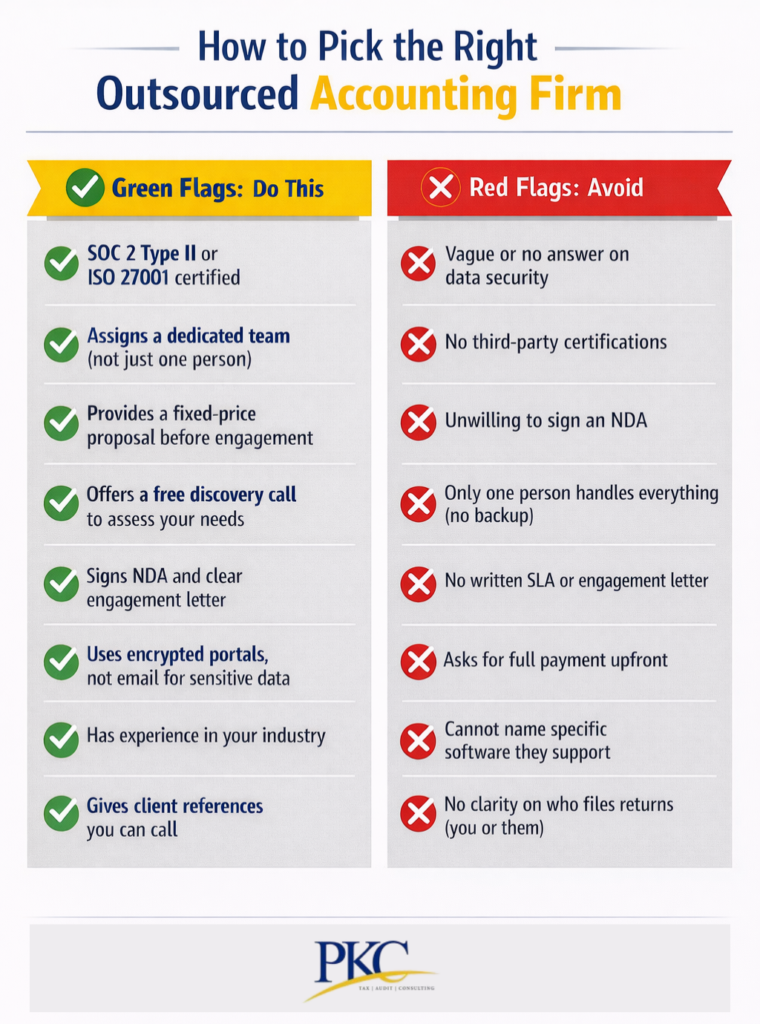
Before you sign an engagement with any outsourced accounting firm, you need to know how that data is handled, stored, and protected.
Security Measures Your Accounting Partner Must Have
Look for tangible, verifiable security controls.
- Encryption: Data must be encrypted both when it’s stored (“at rest”) and when it’s being sent (“in transit”). The industry standard is AES-256 encryption for stored data and TLS 1.2 or higher for data in transit.
- Access Controls: No one should have access to everything. The provider must enforce role-based access controls (RBAC). This means an accountant handling your bookkeeping cannot see your employee payroll records. Multi-factor authentication (MFA) must be mandatory for every single staff member accessing any system.
- Certifications: Ask for a current SOC 2 Type II certification (not Type I, which is a point-in-time check). Type II proves their security controls are actually working over a period of at least six months. ISO 27001 certification for information security management is another strong indicator.
- Employee Vetting: The firm must conduct thorough background checks on all employees who handle client data. In India, this includes criminal background, education, employment history, and address verification.
- Confidentiality Agreements (NDAs): Every employee who touches your data should have signed a legally binding non-disclosure agreement (NDA) with the provider. Your contract with the provider must also have a robust, specific confidentiality clause.
- Data Handling and Destruction: What happens to your data when the engagement ends? The provider must have a clear, documented policy to return or destroy all your data and provide written confirmation within a set timeframe (e.g., 30 days)
Software and Cloud Security
Most outsourced accounting engagements are now on cloud-based platforms like Zoho Books, QuickBooks Online, Tally on Cloud, etc. These platforms come with their own security infrastructure, but that doesn’t remove your responsibility to verify how access is managed.
Specifically, check:
- Whether the firm uses your existing software instance or creates a separate one
- How user access is revoked when staff changes happen on their side
- Whether two-factor authentication is enabled across the tools being used
Regulatory Compliance
India doesn’t yet have a comprehensive data protection law equivalent to GDPR, though the Digital Personal Data Protection Act, 2023 is being implemented in phases.
Even so, any firm handling your financial data has obligations under existing laws: the Income Tax Act, Companies Act, and professional conduct rules for Chartered Accountants set clear boundaries around client confidentiality.
For businesses sharing data across borders, particularly US companies with Indian subsidiaries, additional considerations apply.
Understand what data leaves India, where it goes, and whether that transfer is compliant with applicable regulations on both sides.
Practical Steps Before You Share Anything
- Get the NDA signed before the first document changes hands
- Ask for the firm’s data security policy in writing, not a verbal assurance
- Clarify the data retention and deletion policy at engagement end
- Limit initial access to what’s strictly necessary; expand it once trust is established
- Confirm that ex-employees of the outsourced firm lose access to your data immediately upon exit
Outsourced Accounting for US Companies with Indian Subsidiaries
For US companies operating Indian subsidiaries, the accounting function has to balance two different regulatory systems. The gaps between them can create real risk.
This is one area where outsourced accounting services in India provide particularly clear value.
The alternative, managing Indian compliance from a US headquarters, or hiring a small in-house team in India that lacks cross-border expertise, doesn’t really work well.
What Makes Indian Subsidiary Accounting Different
Indian subsidiaries of foreign companies have to be compliant with:
- Companies Act, 2013: Governs financial statement preparation, statutory audit requirements, board reporting, and ROC filings
- Income Tax Act: Corporate tax, advance tax payments, TDS obligations, and transfer pricing documentation
- GST: Monthly or quarterly return filing, input tax credit reconciliation, and e-invoicing requirements above certain turnover thresholds
- FEMA (Foreign Exchange Management Act): Regulates foreign investment, inter-company transactions, and remittances between the parent and subsidiary
- Transfer Pricing: Any transaction between the US parent and Indian subsidiary must be at arm’s length and documented through an annual transfer pricing study
Missing obligations under any of these delay repatriation of funds, complicate future fundraising, and create problems during audits or acquisitions.
Reporting Across Two Frameworks
US parent companies usually report under US GAAP or IFRS.
Indian subsidiaries are required to prepare financial statements under Indian GAAP (Ind AS for larger entities).
Your outsourced accounting team needs to manage both: maintaining compliant Indian books while also producing reporting packages that your US finance team can consolidate.
This includes:
- Currency translation from INR to USD
- Reconciliation between Indian statutory accounts and US GAAP reporting
- Monthly or quarterly reporting packs in formats your parent company actually uses
- Intercompany transaction documentation and reconciliation
Common Issues US Companies Face
Without dedicated outsourced accounting support in India, issues that come up repeatedly:
- Delayed statutory filings because the US team doesn’t track Indian deadlines
- Transfer pricing documentation left incomplete until just before the audit
- FEMA compliance gaps on intercompany loans or royalty payments
- Indian audit preparation handled reactively, causing delays and additional costs
- No clear owner for day-to-day compliance — tasks fall between the Indian ops team and the US finance function
What a Good Outsourced Firm Handles
For US companies, a capable outsourced accounting firm in India should cover:
| Compliance Area | Key Deliverables |
| Monthly Accounting | Bookkeeping, payroll, GST, TDS |
| Statutory Reporting | Ind AS financials, ROC filings, board resolutions |
| Tax Compliance | Advance tax, corporate tax return, transfer pricing study |
| FEMA Compliance | FC-GPR, FC-TRS, ODI filings, RBI reporting |
| Parent Reporting | US GAAP reconciliation, monthly reporting packs, audit support |
Important Consideration:
Time zone alignment is critical. Your Indian accounting team should have defined overlap hours with US counterparts, enough to handle queries, resolve issues, and meet deadlines without 24-hour delays.
When evaluating outsourced firms, ask how they manage US-India coordination and their typical response times for parent company queries.
How PKC Manages Outsourced Accounting Engagements
At PKC Management Consulting, we don’t just “do your books.” We become an extension of your finance team.
Our approach is built on three pillars: process discipline, technology leverage, and people expertise
Every PKC accounting engagement is staffed by a team of CAs and financial advisors, not junior data entry operators supervised remotely.
The team works off-site, supported by a structured backend, which means your accounting function runs without requiring you to manage or house additional staff.
If you have a specific on-site requirement, we can discuss that during onboarding.
Technology PKC Works With
PKC’s team is proficient across the accounting platforms most Indian businesses actually use:
- Zoho Books
- QuickBooks
- Xero
- Tally
- FreshBooks
If you’re already on one of these platforms, the transition will have minimal disruption. We work within your existing software environment rather than forcing a migration.
For businesses that don’t yet have a structured accounting system in place, PKC helps identify and implement the right one.
What the Accounting Engagement Covers
We offer both full-stack and partial accounting outsourcing services, depending on what your business needs, including:
- Bookkeeping and ledger maintenance
- Accounts payable and receivable management
- Payroll processing with TDS, PF, and ESI compliance
- GST and TDS return filing
- Financial reporting including monthly P&L, balance sheet, cash flow
- MIS reporting and management dashboards
- Budgeting, forecasting, and financial planning
- Audit support and statutory compliance
- CFO-level advisory for businesses that need strategic financial guidance
The scope is defined upfront and documented. You know what’s included before the engagement begins.
How PKC Approaches Client Relationships
A few things stand out in how we structure our engagements.
- Pricing is transparent: fixed retainer models with no hidden add-ons.
- We customise the scope to your actual situation rather than applying a standard template.
- Communication is built into the model. Clients receive regular updates, have a defined point of contact, and can expect quick turnaround on queries.
Getting Started
When you engage PKC for outsourced accounting services, you are not just buying compliance. You are buying reliability.
You get clean books, on-time filings, and a team that actually answers your calls. You stop worrying about GST notices or TDS mismatches. You focus on growing your business.
Ready to make the switch? Book a free 30-minute consultation. We will assess your needs and give you a fixed-price quote.
No pressure. No jargon. Just a clear path to better accounting.