
 Expert verified
TL;DR SummaryBuying a car for business in India unlocks multiple tax-saving tools—from claiming GST Input Tax Credit and 15–30% depreciation under Section 32 to deducting loan interest and running costs. This guide covers 15 legal methods to cut your car purchase tax liability significantly. |
Buying a car for business use in India unlocks the most tax savings — you can claim 15% depreciation on petrol/diesel cars and 40% on EVs under Section 32, deduct loan interest and running costs (fuel, insurance, maintenance) as business expenses, and recover GST paid as Input Tax Credit if the vehicle is used for transport services or goods delivery with a seating capacity of 13 or more.
For individuals buying an electric vehicle, Section 80EEB allows a deduction of up to ₹1.5 lakh on EV loan interest, EVs also attract just 5% GST versus 28% on petrol/diesel cars, and buyers of any car above ₹10 lakh should claim the 1% TCS collected by the dealer as a tax credit when filing their ITR.
Car ownership comes with significant financial implications. One of the biggest factors is taxes. We have your back as we guide you through how to save tax when buying a car.
Explore the different strategies you can use to reduce the tax on your vehicle purchase, whether for private or business use.
Cut Down the Taxes on Your Next Car Purchase: Best Tips
Buying a car is a significant investment. However, if you plan carefully, you can potentially save on taxes. Here are some strategies:
1.
Claim Input Tax Credit (ITC) on Cars – FY 2026–27
If you’re buying a car for your business in FY 2026-27, the GST you pay on it doesn’t have to be a sunk cost. You can claim it back as Input Tax Credit (ITC) and put that money to better use in your business.
Who Can Claim It?
If your business runs taxis, handles logistics, delivers goods, or operates any kind of transport service, you’re in luck. The GST paid on your vehicle purchase can be directly offset against your GST liability — meaning you pay less tax overall.
The New GST 2.0 structure in place, larger vehicles and SUVs now carry a 40% GST rate. That sounds steep — but here’s the silver lining for businesses. You can now claim the entire 40% as ITC with no cess blocking your claim.
If the vehicle is used purely for business, you can also recover GST paid on insurance, repairs, maintenance, and even lease or rental charges. Every rupee of GST you’ve paid is a rupee you could be getting back.
IMPORTANT:
Not available for personal use cars.
Applicable only for vehicles with a seating capacity of 13 or more — or those used for specific commercial purposes like transport services, goods delivery, or driving schools. If your car doubles up as a personal vehicle, ITC won’t apply.
If you are purchasing a car for business use, you can claim the GST (Goods and Services Tax) paid on the car as Input Tax Credit.
This is applicable if the car is used for commercial purposes, like taxis, logistics, or transport services.
| IMPORTANT |
| Not available for personal use cars |
| Available only for vehicles with a seating capacity of 13 or more Or Used for specific commercial purposes like transportation services |
2.
Section 80EEB: Buy EV, Save Tax
If you’ve been thinking about switching to an electric vehicle, FY 2026-27 might just be the perfect time to make that move. Under Section 80EEB, you can claim a deduction of up to
₹1.5 lakh on the interest you pay on your EV loan.
This deduction is exclusively for individuals — so if you’re planning to buy your first EV this year, make sure your loan is from a registered bank or NBFC. That one step could save you thousands in taxes before March 2027.
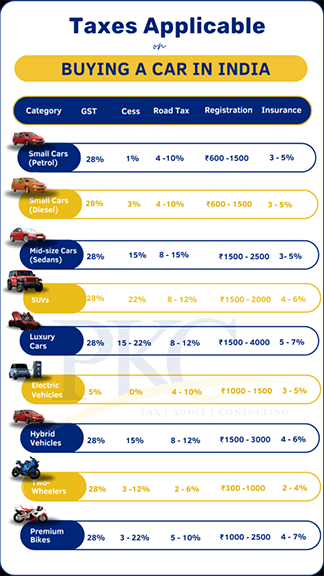
EVs are taxed at just 5% GST, while petrol and diesel cars attract a hefty 28%. So by the time you factor in the lower purchase cost and the annual interest deduction, you’re looking at a pretty compelling financial case — not just an environmental one. This can result in substantial tax savings upfront. To maximize your overall tax benefits, explore PKC India’s comprehensive
Tax Planning Services — designed to help individuals and businesses make the most of every legal deduction available to them.
Under Section 80EEB, you can claim a deduction of up to Rs 1.5 lakh on the interest paid on an EV loan.
| 80EEB deduction is available only for individuals and can be claimed once per person when purchasing an EV for the first time. |
They also attract a lower GST rate of 5%, compared to 28% on petrol and diesel cars. This can result in substantial tax savings upfront. To maximize your overall tax benefits, explore PKC India’s comprehensive Tax Planning Services — designed to help individuals and businesses make the most of every legal deduction available to them.
3.
Take Advantage of Interest Deduction
If you are self-employed and use the vehicle for business purposes, you can claim the interest paid on a car loan as a business expense.
This deduction reduces your taxable income. However, salaried individuals cannot claim this unless the vehicle is primarily used for business activities.
4.
Claiming Expenses for Business Use
If the car is used for business purposes, you can claim the expenses related to the car—such as fuel, maintenance, repairs, and driver salary—as business deductions.
This reduces your taxable income. This benefit is not available if the car is for personal use.
Keeping detailed records of these expenses is essential to substantiate claims during tax assessments.
5.
Buy a Car in a State with Lower Road Tax
Road tax varies significantly across Indian states. Some states offer lower rates for specific vehicle types or electric cars.
By buying a car in a state with lower road tax, you can save on this cost.
Compare road tax rates across states before making a purchase.
6.
Business Car Depreciation Benefits Under Section 32
Under Section 32 of the Income Tax Act, the depreciation on your business car is a legitimate expense that quietly reduces your taxable income year after year.
Simple rule — petrol/diesel cars get 15%, electric vehicles get 40%. Buy late in the year? You’ll get half the rate if the car is used for less than 180 days in FY 2026-27.
This only applies to cars used for business. Personal vehicles don’t qualify. If you own other business assets too, check out our guide on Save Tax on Sale of Commercial Property— same idea, bigger numbers.
WDV vs SLM depreciation — business vehicles (FY 2026-27)
Under Section 32 of the Income Tax Act. WDV is used for income tax; SLM is used for company accounts.
|
Vehicle type |
Rate |
WDV method (Income Tax) |
SLM method (Company Books) |
|
Petrol / diesel car |
15% |
Applied on reducing book value each year. Higher deduction in year 1, decreases over time. |
Fixed % on original cost every year. Equal deduction across the asset life. |
|
Electric vehicle (EV) |
40% |
40% on WDV each year. Significant tax saving in early years — ideal for tax planning. |
40% on original cost p.a. Asset fully written off in ~3.3 years on books. |
If the car is purchased for business use, you can claim depreciation as an expense under Section 32 of the Income Tax Act.
Depreciation rates are usually 15% for regular vehicles and 30% for electric vehicles.
This reduces your taxable income over the years.
This reduces your taxable income over the years. If you own business assets beyond vehicles, also read: Save Tax on Sale of Commercial Property — another practical guide to reducing your tax liability on high-value asset transactions.
7.
Check for State-Specific Incentives
Some states in India offer additional incentives or rebates for purchasing electric vehicles or vehicles that meet certain emission standards.
Research state-specific schemes to take advantage of any available benefits.
8.
Don’t Forget the Tax Collected at Source (TCS)
If you are buying a car valued over Rs 10 lakh, or make cash payments exceeding Rs 2 lakh, the dealer is required to collect 1% TCS (Tax Collected at Source).
You can claim this amount as a tax credit when filing your income tax return, reducing your overall tax liability.
9.
Time Your Purchase Wisely
During certain times, like financial year end or festive seasons, dealers and states may offer temporary reductions or exemptions on road taxes, registration fees, or other charges.
By timing your purchase during these periods, you can reduce costs.
10.
Reimburse Through Salary Structure
This is applicable for salaried employees whose employer offers a car lease program or provides car allowance.
You can get reimbursed for expenses like fuel, maintenance, or loan interest. This can help reduce your taxable salary, as these reimbursements are not taxed.
11.
Opt for Pre-Owned Cars
Used cars attract a lower tax rate compared to new cars. The GST on used cars is generally lower—between 12% to 18%, depending on the car type.
Additionally, some states may offer lower road tax for second-hand vehicles.
12.
Purchase Car for Specific Commercial Use
If you buy a car for commercial purposes, such as for a taxi service, logistics, or business operations, you can claim tax benefits like Input Tax Credit (ITC) on GST, depreciation, and business expenses related to the car.
This helps in reducing the overall tax liability of your business.
13.
Tax Benefits on Car Insurance
This again is applicable for business use vehicles. If the car is used for business purposes, the premium paid for car insurance can be claimed as a business expense.
This reduces your taxable income, leading to tax savings.
14.
Take Advantage of Lower Registration Fees
Buying a car in India and registering it in a state with lower registration fees can lead to significant tax savings.
For instance, Uttar Pradesh recently waived registration fees on strong hybrid vehicles, allowing buyers to save up to Rs. 3.5 lakhs.
15.
Choose a Car with a Lower Engine Capacity
Cars with lower engine capacity (especially under 1500 cc) are often subject to lower road tax and GST rates compared to luxury or high-engine capacity vehicles.
Choosing a car with a smaller engine can help reduce your tax burden both at the time of purchase and during ownership.
Need Help Maximizing Your Tax Savings?” Our expert team at PKC India offers comprehensive Tax Planning Services tailored for individuals and businesses. Whether you’re buying a car or planning your annual taxes — we help you save more, legally. Whether you’re buying a car or planning your annual taxes — we help you save more, legally. Talk to a Tax Expert Today and get a FREE 30-minute consultation with our team.
Have additional tax questions?
Frequently Asked Questions
Yes. If the car is used for business purposes, you can claim depreciation, loan interest, fuel, maintenance, and other expenses as tax deductions.
Businesses can claim depreciation, operating expenses, loan interest, and eligible GST ITC on commercially used vehicles.
Hybrid cars currently do not enjoy the same GST or tax benefits available to pure electric vehicles.
No. Road tax benefits for EVs vary from state to state.
Section 32 allows businesses to claim depreciation on vehicles, reducing taxable profits over time.
Tax benefits are generally available only if the vehicle is used for taxable business or professional activities in India.
Yes. Eligible businesses can claim GST Input Tax Credit (ITC) on commercial vehicles used for transportation, logistics, or other approved commercial activities.
You can save GST on a car purchase by claiming Input Tax Credit (ITC) if the vehicle is bought for business use and you are registered under GST.
To claim tax benefits on a car purchase, ensure the vehicle is used for business, include loan interest as a business expense, and maintain documentation to support your claims during tax filing.
Buying a car without GST is not possible, but you may explore options like purchasing from a private seller or opting for certain exemptions available for specific vehicle types like EVs.
Salaried employees usually cannot claim tax benefits on car loans unless the vehicle is an electric vehicle (EV), which allows for a deduction on interest payments under Section 80EEB.