 Expert verified
| TL;DR Summary |
| Big 4 firms pay higher stipends and carry stronger brand value for corporate or MNC careers, but confine articles to one service line with limited rotation. Mid-size firms like PKC pay less but deliver broader exposure across audit, tax, GST, and compliance, better work-life balance, and a higher chance of a post-qualification offer. The right choice depends on whether you’re aiming for a corporate/Big 4 career or independent practice and generalist skills. |
Big 4 articleship in Chennai pays more (₹12,000-₹22,000/month) and builds stronger corporate brand value, but locks you into one service line for the full two years.
Mid-size firms like PKC pay less (₹6,000-₹12,000/month) but offer audit, tax, GST, and compliance exposure across all two years, plus a 60-80% post-qualification retention rate.
Big 4 firms (Deloitte, EY, KPMG, PwC) primarily serve large corporates, listed entities, multinational companies, and highly complex cross-border engagements. Mid-size CA firms generally offer more partner accessibility, faster response times, lower engagement costs, and stronger value for SMEs, family businesses, and growing enterprises. The right choice depends on your business size, compliance complexity, growth stage, and advisory requirements. Neither model is universally superior.
Every year, thousands of Indian businesses face the same question when it is time to appoint or change their CA firm: do we go with a Big 4, or does a well-regarded mid-size firm serve us better?
The decision sounds straightforward. It is not.
Business owners often default to assuming a bigger firm means better service. Finance managers assume Big 4 equals better audit quality. Founders of funded startups assume investors will only accept Big 4-audited financials. Most of these assumptions are only partially true, and some are outright wrong depending on your business profile.
The real issue is that Big 4 firms and mid-size CA firms are not competing for the same kind of client. They are built for different business complexities, different scales, and different expectations around access, responsiveness, and cost. Choosing the wrong firm type does not just affect your CA bill — it affects how well your compliance gets done, how quickly you get answers when issues arise, and whether the advice you receive is actually tailored to your situation.
This article breaks that decision down honestly, without promotional spin. Whether you are a founder, CFO, finance manager, or a business owner in Chennai or anywhere in India, the comparison below should help you think clearly about which firm model fits where your business is today and where it is headed.
Understanding the Indian CA Firm Landscape
India has one of the most structured and regulated accounting professions in the world. The Institute of Chartered Accountants of India (ICAI) oversees over 3.5 lakh registered CAs and more than 90,000 registered firms. Within that universe, the landscape broadly divides into four tiers.
The Big 4 (Deloitte, EY, KPMG, PwC) operate through affiliate and member firm structures in India given FDI restrictions on professional services. Their Indian arms – Deloitte Haskins & Sells, S.R. Batliboi & Associates (EY), BSR & Co. (KPMG), and Price Waterhouse (PwC) – are among the largest audit and advisory practices in the country. They serve primarily listed companies, large private conglomerates, MNCs, and regulated entities like banks and insurance companies.
Mid-size CA firms occupy the next tier. These are firms with five to forty partners, often operating from one or two cities, with deep domain expertise in audit, tax, and advisory. Many have been around for decades and have developed strong industry specializations. In Chennai alone, several mid-size firms serve clients across manufacturing, healthcare, retail, real estate, and IT. PKC Management Consulting, with over 37 years of experience and more than 200 professionals, sits in this category with a distinct emphasis on business process improvement alongside financial advisory.
Small CA firms typically operate with one to four partners and serve micro-businesses, individual proprietors, and small traders primarily on compliance work. Boutique specialists are niche practices focusing on narrow domains such as transfer pricing, FEMA advisory, or insolvency work.

Chennai’s Business Ecosystem – A Strong Mid-Size CA Firm Landscape
Chennai’s accounting ecosystem mirrors this structure closely. The city is home to a significant concentration of manufacturing companies, auto component firms, IT companies, healthcare chains, retail groups, and family-owned conglomerates. This client diversity has produced a mid-size CA firm ecosystem that is unusually strong, with firms offering capabilities that would typically require a Big 4 engagement in other markets.
Big 4 vs Mid-Size CA Firms at a Glance
The table below provides a structured comparison across the key criteria that matter most to business owners and finance leaders when choosing a CA firm.
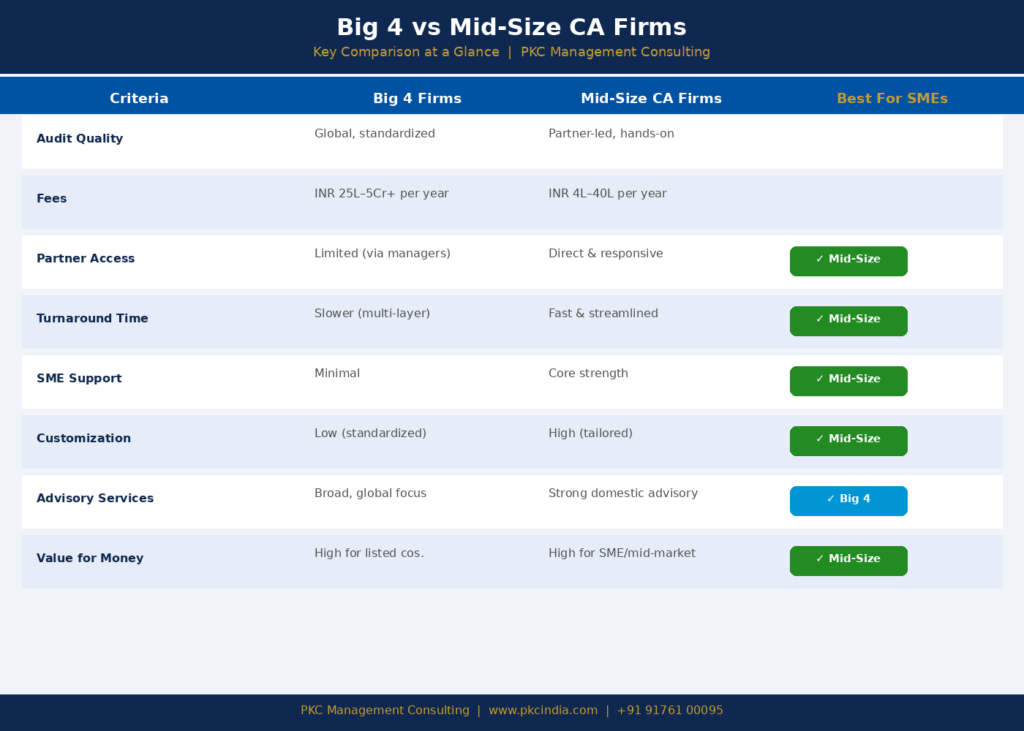
Infographic: Big 4 vs Mid-Size CA Firms – Key Criteria Comparison
| Criteria | Big 4 Firms | Mid-Size CA Firms |
|---|---|---|
| Audit Quality | Global, standardized (IFRS, listed entities) | Partner-led; deep client familiarity |
| Compliance Expertise | Broad, dedicated teams per law area | Integrated; one team, multiple compliance areas |
| Advisory Services | Extensive, global & cross-border | Strong domestic: tax, process, business consulting |
| Fees | High; time-and-material billing | Moderate to competitive; retainer & fixed-fee models |
| Turnaround Time | Longer; hierarchical review process | Faster; fewer layers, direct partner communication |
| Partner Accessibility | Limited; accessed via managers/directors | High; partners directly engaged on most mandates |
| Industry Specialization | Deep in select sectors (BFSI, MNCs) | Broad across SME sectors; strong local knowledge |
| SME Support | Minimal – not their primary market | Core strength; SMEs are the primary clientele |
| Startup Support | Available but expensive for early-stage | Practical, cost-effective startup solutions |
| International Reach | Strong; global network, cross-border | Limited; referral-based for international matters |
| Customization | Low; standardized service delivery | High; solutions tailored to business size |
| Value for Money | High for complex/listed mandates only | High for most SME and mid-market businesses |
Service Quality: What Each Firm Type Actually Delivers
This is where the comparison gets more nuanced than most discussions allow.
Audit
Big 4 audit quality is standardized around global methodologies. For a company preparing for an IPO, a listed entity under SEBI scrutiny, or an MNC subsidiary reporting to a global parent, the Big 4’s structured audit frameworks, global templates, and peer-review processes are genuinely valuable. They handle complex consolidations, group reporting under IFRS, and listed-company-level disclosures with embedded processes that are hard to replicate.
For a mid-sized manufacturing company, a family-owned trading business, or an MSME with INR 50 crore to INR 500 crore revenue, the same level of standardization often produces the opposite of value. The client becomes a small file in a large team with limited partner involvement. The audit gets done, technically, but the business insight that should accompany it rarely arrives.
Mid-size CA firms serving this segment tend to offer partner-led audits where the engagement partner actually knows the client’s business, visits the plant or warehouse, and signs off on findings they personally reviewed. Internal audit from a firm like PKC goes beyond tick-and-complete, looking at process efficiency, inventory controls, and receivables management as part of the assignment. That combination of financial audit with operational insight is something most Big 4 teams will not provide on sub-INR 500 crore mandates.
Taxation
Tax advisory is an area where the mid-size firm model has historically produced strong outcomes for Indian businesses. Both direct tax and GST involve a mix of planning, compliance, filing, and litigation. Big 4 tax teams are outstanding for complex transactions – mergers, cross-border restructuring, transfer pricing disputes, and FEMA-related matters.
For SMEs, manufacturing businesses, and family-owned enterprises, the challenge is rarely transaction complexity. It is accuracy of return filing, proactive identification of tax-planning opportunities, managing notices and scrutiny, and having someone available when the GST officer sends a query. Mid-size firms tend to perform better on responsiveness and cost for this category of work.
Compliance
Statutory compliance encompasses ROC filings, GST returns, TDS, PF, ESI, and labour law requirements. Big 4 firms typically do not take on this work directly for most clients, routing it through affiliated accounting firms or smaller associates. Mid-size CA firms, especially those with integrated practices, handle end-to-end compliance under one roof, which reduces the coordination overhead for the client.
Advisory and Virtual CFO
The Big 4 advisory practices are among the most sophisticated in the world for large-scale transformations, M&A due diligence, and enterprise risk management. Below INR 1,000 crore revenue, these teams are usually too expensive and often underutilised.
Mid-size CA firms with a genuine advisory practice fill this gap effectively. Outsourced CFO or Virtual CFO services from mid-size firms like PKC offer smaller companies the financial leadership they need at a fraction of the cost of hiring a full-time CFO. Services typically include MIS reporting, fundraising support, cash flow monitoring, lender management, and financial controls implementation.
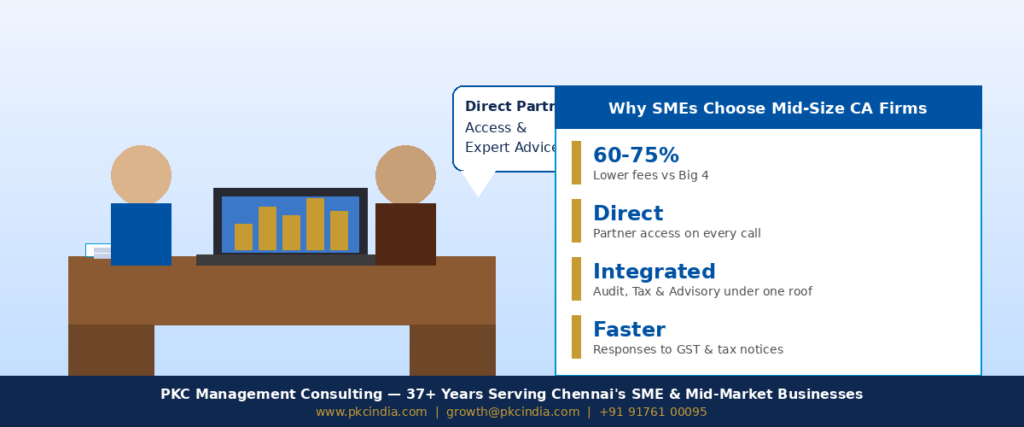
Direct Partner Access – Why SMEs Choose Mid-Size CA Firms
Risk Management and GRC
Governance, Risk, and Compliance (GRC) work has traditionally been a Big 4 strength for large corporations. However, mid-size firms with a structured internal audit practice now offer credible GRC services for businesses that need risk frameworks, process controls, and compliance monitoring without the cost of a Big 4 engagement. For companies in the INR 100 crore to INR 2,000 crore range, this represents meaningful value.
Fees and Engagement Costs: What Businesses Should Expect
Fees are where many businesses get surprised, in both directions.
Big 4 fees are structured around time-and-material billing, often with a daily rate card that reflects their overheads, global methodologies, and partner involvement. For a standard statutory audit, a large manufacturing company might expect to pay between INR 25 lakh and INR 1.5 crore annually depending on complexity, group structure, and number of entities.
Mid-size CA firms typically price on a combination of retainer, fixed fee, and project billing. Retainers are common for ongoing tax and compliance work. Audit fees are usually fixed at the start of the engagement.
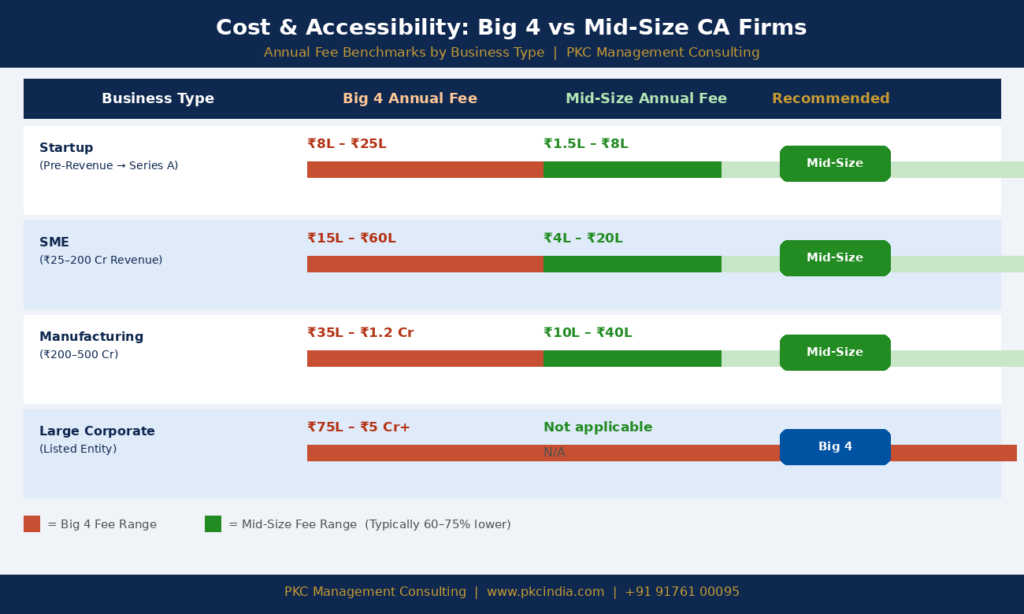
Infographic: Annual Fee Benchmarks – Big 4 vs Mid-Size CA Firms by Business Type
| Business Type | Big 4 Annual Fee | Mid-Size Annual Fee | Recommendation |
|---|---|---|---|
| Startup (pre-revenue to Series A) | INR 8L – 25L | INR 1.5L – 8L | Mid-Size Firm |
| SME (INR 25–200 crore revenue) | INR 15L – 60L | INR 4L – 20L | Mid-Size Firm |
| Manufacturing (INR 200–500 crore) | INR 35L – 1.2 crore | INR 10L – 40L | Mid-Size Firm |
| Large Corporate / Listed Entity | INR 75L – 5 crore+ | Not typically applicable | Big 4 |
Hidden costs to watch for with Big 4 engagements:
- Out-of-pocket expenses, travel, accommodation, and printing costs are often billed separately
- Engagement extensions due to delays in internal processes are billed at daily rates
- Queries and advice outside the agreed scope attract additional fees
- For smaller mandates, the billing structure can result in more invoices than insights
Mid-size firm engagement structures:
- Predictable annual retainers for compliance work – the client knows exactly what they will pay every month
- Advisory work may be project-billed or milestone-based
- The absence of large firm overheads means more of the fee goes toward actual work rather than administrative infrastructure
Accessibility and Client Experience
Accessibility is, in practice, one of the biggest differentiators between firm types – and one of the least discussed.
When a business owner calls their CA, who answers? In a Big 4 engagement for a mid-market company, the answer is usually a manager or senior associate. The partner who signed the proposal is typically not available for routine queries. Escalation to partner-level requires either a serious issue or a formally scheduled meeting. This is not a criticism of Big 4 firms; it is simply a function of their scale.
At a mid-size CA firm, especially one with a focused practice, partner accessibility is structurally different. Partners are typically involved in the day-to-day of client engagements. They answer calls, join client meetings, review advice personally, and are reachable when a compliance deadline is approaching. For a business owner managing multiple priorities, this direct access has real operational value.
Response time is the other dimension. For time-sensitive matters – a GST notice, a tax scrutiny summons, or a board-level financial decision that needs an advisor’s input – mid-size firms generally move faster. There is less internal bureaucracy. A partner can give a considered view within hours rather than days.
Long-term relationship quality also differs. Mid-size firms tend to develop deep familiarity with their clients over time, sometimes over decades. Partners understand the business history, the promoter’s thinking, the seasonal patterns, and the recurring issues. This institutional memory makes advisory conversations far more productive.
Why Many SMEs Prefer Mid-Size CA Firms
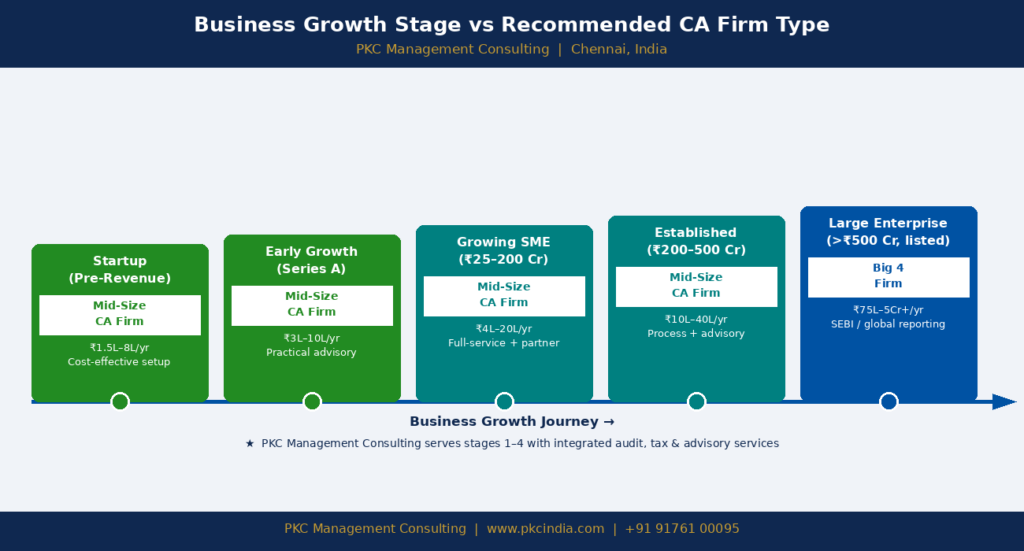
Infographic: Business Growth Stage vs Recommended CA Firm Type
The short answer is that mid-size CA firms are built for how SMEs actually operate.
An SME’s financial needs are not simple. They involve multi-state GST compliance, payroll, PF and ESI, statutory audit, income tax planning across the promoter and entity levels, ROC filings, and periodic advisory support for business decisions. Managing all of this requires a firm that can integrate across these areas, not one that routes different pieces to different teams at different rates.
Cost efficiency is real and measurable. A mid-size CA firm with the right capabilities can handle all of the above for a fraction of what a Big 4 would charge, often with faster turnaround and more direct communication.
Customization matters more than most SMEs realize. The way a mid-size firm approaches a manufacturing company’s audit is different from how they approach a retail business – not because of a standardized methodology but because the partner has seen the sector, knows the issues, and adjusts accordingly.
In Chennai specifically, the mid-size CA firm ecosystem has evolved in lockstep with the city’s industrial base. Firms with long track records serving auto component manufacturers, textile companies, healthcare groups, and IT service providers have developed sector insights that are genuinely valuable to those industries.
When a Big 4 Firm Is the Better Choice
This is not a one-sided argument. There are situations where Big 4 firms are clearly the better option, and businesses should engage them without hesitation when those conditions are met.
- IPO preparation and listed company compliance – SEBI requires listed entities to appoint statutory auditors from a defined list; Big 4 signals credibility to institutional investors, SEBI, and stock exchanges
- Large MNC subsidiaries needing Indian statutory audit aligned with group reporting requirements under IFRS or US GAAP
- Complex cross-border transactions – M&A involving foreign parties, inbound FDI structuring, transfer pricing at scale, and FEMA-related advisory
- Regulatory-facing entities such as banks, insurance companies, and large NBFCs where Big 4 auditors are required by regulatory mandate
- Highly complex group structures with multiple subsidiaries, international holding companies, and sophisticated intercompany arrangements
The honest summary: if your business is listed, has complex global structures, or is actively working toward a public offering, the Big 4 is likely the right choice. For the vast majority of Indian businesses, that scenario does not apply.
Which CA Firm Is Right for Your Business?
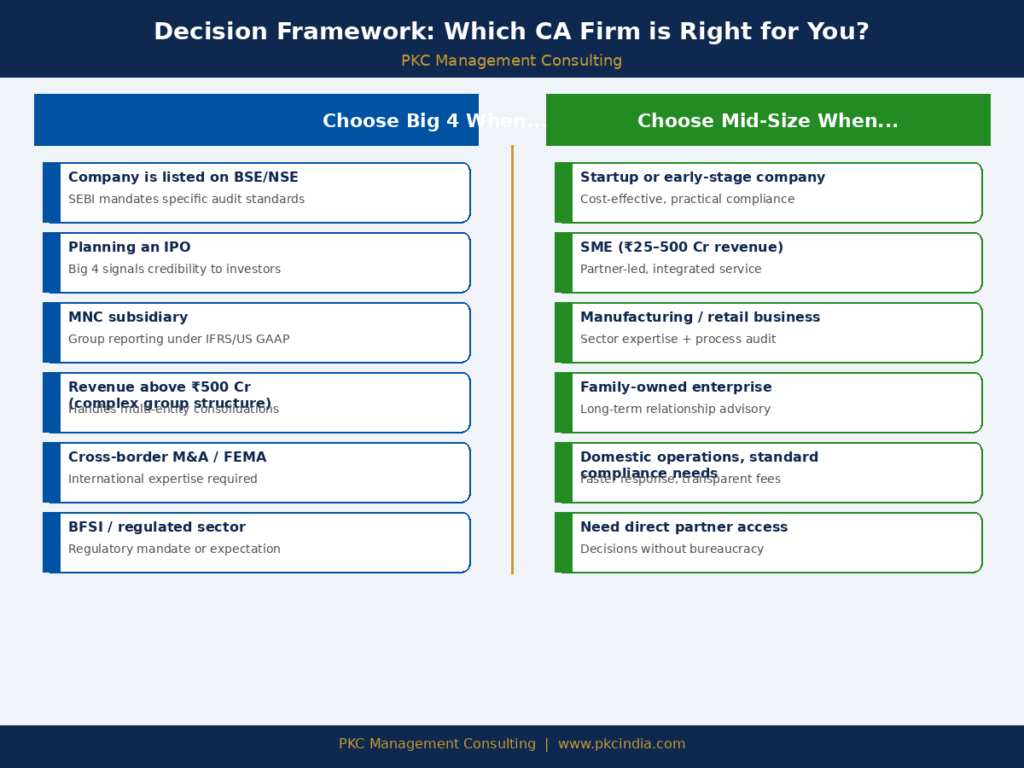
Infographic: Decision Framework for Choosing the Right CA Firm
| Business Type | Recommended Firm | Key Reason |
|---|---|---|
| Startup (pre-revenue, bootstrapped) | Mid-Size CA Firm | Cost, integrated compliance, practical advisory |
| Startup (Series A funded) | Mid-Size CA Firm* | VC investors may want Big 4 for ESOP, financial modeling |
| Small Business (< INR 10 crore) | Mid-Size or Small CA Firm | Cost efficiency, direct access |
| Growing SME (INR 25–200 crore) | Mid-Size CA Firm | Full-service capability, partner involvement, cost |
| Manufacturing Company | Mid-Size CA Firm (sector exp.) | Process audit, inventory controls, cost advisory |
| Family-Owned Business | Mid-Size CA Firm | Long-term relationship, promoter advisory, succession |
| Large Enterprise (>INR 1,000 crore) | Mid-Size or Big 4 | Evaluate complexity vs. cost trade-off |
| Listed Company | Big 4 | SEBI requirements, investor expectation |
| MNC Subsidiary | Big 4 | Group reporting alignment, international network |
Why Chennai Businesses Are Increasingly Choosing Quality Mid-Tier Firms
Chennai’s business environment has always valued practicality and relationship-based service delivery. The city has a strong industrial base in auto components, manufacturing, textile retail, real estate, and healthcare – sectors that require hands-on financial management rather than standardized audit processes designed for listed companies.
What has changed in the past decade is the service capability of Chennai’s mid-size CA firms. Firms that were once seen as primarily compliance-focused have evolved into full-service advisory practices. They have invested in technology, talent, and specialization. They understand GST, international taxation, and business process improvement at a level that was previously only available from larger firms.
For a closer look at what sets Chennai’s best CA firms apart, from partner accessibility to sector specialization, see our detailed breakdown of the city’s top-tier practices
For Chennai business owners, the combination of local industry knowledge, accessible partners, competitive fees, and end-to-end service has made quality mid-tier firms the practical choice across a broad range of business types. The Big 4 are not absent from Chennai but their focus is concentrated on a relatively small number of large clients.
Turnaround time also matters in Chennai’s business culture. Decisions get made quickly, and business owners expect their advisors to keep pace. Mid-size firms with streamlined internal processes consistently outperform larger firms on responsiveness for the types of queries that SMEs actually face.
Where PKC India Fits in the Chennai CA Landscape
PKC Management Consulting has been part of Chennai’s business advisory ecosystem for over 37 years. With more than 200 professionals and a client base of over 1,500 businesses, it operates at the stronger end of the mid-size firm spectrum.
What distinguishes PKC is its integration of audit, tax, and business consulting under a single practice. Most CA firms handle compliance and audit. PKC extends into business process improvement, ERP implementation, operational consulting, and outsourced CFO services. For a growing business that needs both financial discipline and operational efficiency, this breadth is genuinely useful.
Audit and Assurance
PKC’s audit practice covers financial audits, internal audits, concurrent audits, and process audits. The firm’s process audit capability – which evaluates operational workflows alongside financial controls – is distinctive and valued by manufacturing and retail clients who need more than a tick-box statutory audit. Explore PKC’s audit and assurance services to see how our process-audit approach goes beyond a standard statutory sign-off.
Tax Advisory
The team handles income tax planning, GST advisory, TDS compliance, tax litigation, and transactional advisory including business acquisitions and FEMA matters. For clients navigating complex tax situations including income tax searches and scrutiny, the firm’s track record includes cases that would typically require a Big 4 practice.
Outsourced CFO Services
This service line is growing significantly in relevance for funded startups and scaling businesses. PKC’s outsourced CFO model provides MIS reporting, investor liaison, financial modelling, lender management, and compliance oversight at a cost structure that works for companies that are not yet ready for a full-time CFO hire.
Business Advisory
The management consulting practice covers process re-engineering, inventory management, procurement optimization, employee performance systems, and ERP implementation. This operational focus complements the financial advisory work and addresses a gap that most CA firms do not attempt to fill.
SME and Mid-Market Focus
PKC’s client portfolio spans retail chains, auto component manufacturers, healthcare groups, real estate developers, educational institutions, and IT companies. This sectoral diversity has built institutional knowledge across the industries that form the backbone of Chennai’s economy.
Final Thoughts
The Big 4 vs mid-size CA firm debate does not have a single correct answer. It has a correct answer for each type of business.
If your company is listed, preparing to list, or managing complex international structures, a Big 4 audit is likely worth the cost and the trade-offs that come with it.
For the vast majority of Indian businesses – including privately held companies with significant revenues, family-owned enterprises, manufacturing businesses, SMEs, and growth-stage companies – a quality mid-size CA firm offers better partner accessibility, more responsive service, stronger local industry knowledge, and significantly lower cost. The assumption that bigger always means better does not hold here.
What matters is fit. A good mid-size firm with the right sector experience and a genuine advisory practice will outperform a Big 4 team that treats your mandate as a low-priority file.
Evaluate any CA firm on these four dimensions:
- Partner-level involvement in your engagement
- Depth of experience in your sector
- Responsiveness when things go wrong
- Clarity of fees
Those factors will serve you better than brand name alone.
Frequently Asked Questions
Q: What is the difference between Big 4 and mid-size CA firms?
Big 4 firms are the four largest audit and advisory networks in the world, operating in India through affiliate structures. They primarily serve listed companies, large MNCs, and highly complex engagements. Mid-size CA firms typically serve SMEs, family businesses, and growing enterprises, offering more partner-direct involvement, faster response times, and lower fees. The core difference is not quality but client focus and service model.
Q: Which CA firm is best for SMEs?
A quality mid-size CA firm is generally the better fit for SMEs. SMEs benefit from direct partner access, integrated compliance handling, sector-specific knowledge, and cost structures that align with their scale. Big 4 firms tend to assign smaller mandates to junior teams, and the fee levels are often disproportionate to the complexity of the work involved.
Q: Are Big 4 firms worth the cost for a growing Indian company?
For most growing Indian companies that are privately held, the answer is no. The cost premium of a Big 4 engagement delivers genuine value when the company is preparing for an IPO, dealing with international investors or regulators, or managing highly complex cross-border structures. For standard statutory audit, tax, and compliance needs, a well-regarded mid-size CA firm provides equivalent or better service at a fraction of the cost.
Q: Do mid-size CA firms provide the same audit quality?
Quality varies by firm in both categories. A well-run mid-size firm with experienced partners and rigorous processes delivers high-quality audits for the client types they serve. The Big 4 advantage is in global methodology alignment, IFRS experience, and listed-company frameworks. For domestic SME and private company audits, these advantages are less relevant.
Q: Which CA firms are popular in Chennai?
A: Chennai has a strong mid-size CA firm ecosystem. PKC Management Consulting is among the well-established names with a multi-disciplinary practice covering audit, tax, and business consulting. For Big 4 presence, Chennai offices of Deloitte, EY, KPMG, and PwC primarily serve large corporate and MNC clients in the city.
Q: Can startups benefit more from mid-size firms?
A: Yes, in most cases. Early-stage startups need practical, cost-effective help with company incorporation, compliance setup, GST registration, tax filings, and basic financial controls. Mid-size CA firms handle this well and at reasonable cost. The exception is a VC-funded startup where investors require a Big 4 for statutory audit from the first round, which is increasingly rare below Series B.
Q: How do CA firm fees differ between Big 4 and mid-tier firms?
A: Big 4 fees are structured around time-and-material billing with premium rate cards. A statutory audit for a mid-sized company might start at INR 25 lakh to INR 50 lakh annually with a Big 4. A comparable mid-size CA firm might handle the same engagement for INR 8 lakh to INR 20 lakh, with better partner access and more integrated advisory. The fee gap widens significantly as the scope of work expands.