
 Expert verified
| TL;DR Summary |
| Most ERP failures in India stem from weak process readiness, poor stakeholder alignment, and treating go-live as the finish line rather than the start of adoption. This guide covers how to evaluate an ERP partner, what a proper implementation phase-gate looks like, and why PKC stays engaged well past go-live. |
There’s a pattern in most ERP failures in India that rarely gets acknowledged: most ERP projects in India don’t fail because the software was bad. They fail because the business wasn’t ready, critical issues were left unaddressed during implementation, or the go-live was treated as a finish line instead of a starting gun.
If you’re evaluating ERP implementation consultants in India, chances are you’ve heard stories of projects that ran months behind schedule thereby missing critical deadlines, exceeded budgets significantly, and struggled to deliver the expected business outcomes. Unfortunately, such experiences are not uncommon. The good news is that with the right implementation approach and governance framework, ERP projects can be delivered successfully and create lasting business value.
This guide is for business owners and operations heads who are about to make one of the most significant technology decisions of their organization’s life. It won’t sell you a product. It will help you ask the right questions, recognize the right partner, and walk into this process with your eyes open.
What Does an ERP Consultant Actually Do?
People conflate the ERP vendor and the ERP consultant all the time. They are not the same thing and mixing them up is one of the first mistakes companies make.
An ERP vendor sells and develops the software. SAP, Oracle, Microsoft Dynamics, Zoho, Tally -these are vendors. Their sales teams will tell you their product solves everything. Sometimes it does. Often, it solves everything in theory and very little in your specific context.
An ERP consultant is the translator. They act as a bridge between your business reality and the software’s capabilities. A good one will:
- Assess your process readiness before recommending any software. If your inventory management is a mess, no ERP fixes that, it merely digitises the mess.
- Help you select the right platform based on your industry, headcount, transaction volume, integration needs, and budget. It’s all about choosing the right platform, at the right time, for the right business context.
- Map your existing workflows onto the system, identifying gaps and recommending either process changes or customisations.
- Manage the implementation project – data migration, customization, testing, training, and go-live support.
- Manage organizational change and user adoption, ensuring teams embrace the new ERP system instead of relying on the spreadsheets they’ve trusted for years.
- Stay engaged during the make-or-break 60–90 days post-go-live, when employees test every process, discover every edge case, and occasionally insist that their old Excel sheet was faster. The focus is on driving adoption, resolving issues, and ensuring the new system becomes the preferred way of working.
“An ERP consultant’s job is 30% technical and 70% human. If they don’t understand your business, they can’t configure the system. If they can’t manage change, your team will route around it.” – A truth that becomes increasingly evident as an ERP project moves from configuration to adoption.
As Peter Senge rightly said, “People don’t resist change. They resist being changed.” And to add tools alone don’t transform organizations – people do.
That’s why managing people effectively is critical to the success of any ERP implementation.
ERP Selection vs ERP Implementation: Two Different Skills
Here’s something most firms won’t tell you: ERP selection and ERP implementation require fundamentally different competencies, and not every firm does both well.
ERP Selection
ERP selection is an analytical, process-oriented exercise. It involves understanding your business model and transaction volumes, creating a requirements matrix across finance, inventory, procurement, HR, and operations, running structured demos across shortlisted vendors, and making a recommendation that serves you in year five, not just year one.
ERP Implementation
ERP implementation is an execution sport. It requires deep functional knowledge in the modules being deployed, data migration expertise, training design and delivery, and strong stakeholder management. In many cases, the real bottleneck isn’t the software at all – it’s outdated workflows the ERP is being asked to digitise as-is. That’s often the trigger for a parallel business process re-engineering exercise before or alongside implementation. Some boutique firms are exceptional at selection but have thin bench strength for a multi-module implementation. Some large system integrators are excellent at delivery but will hand you a cookie-cutter configuration that ignores your edge cases. Knowing what you need at each stage shapes which partner you engage.
How to Evaluate an ERP Consulting Firm in India
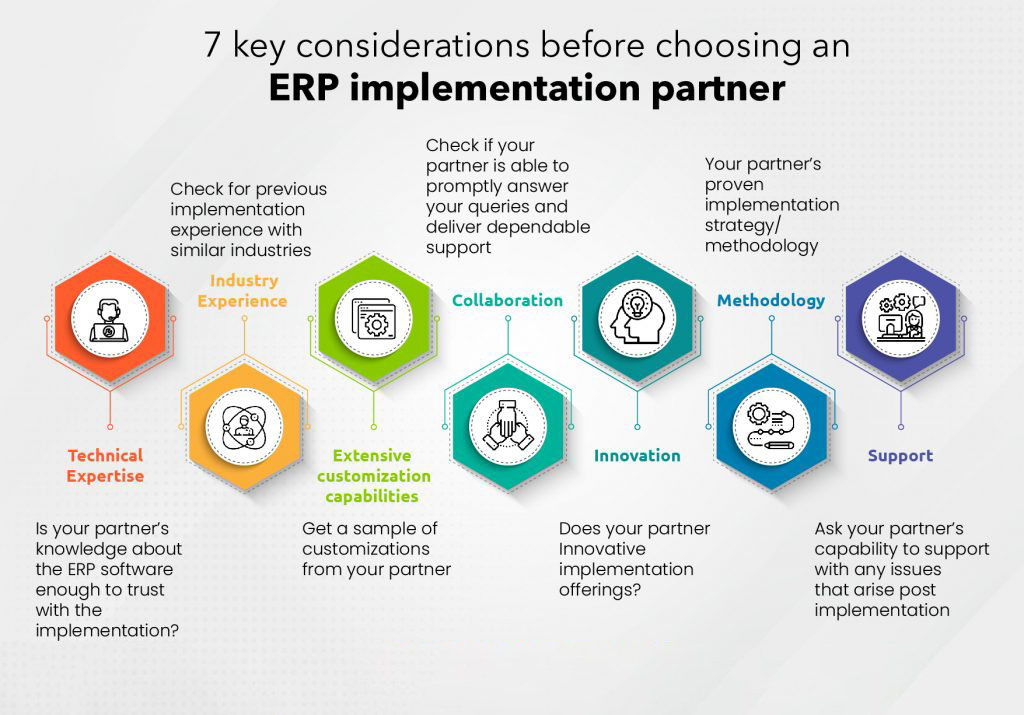
1. Deep Understanding of Your Business Before Design
A good ERP consultant doesn’t start with software configuration, they start with understanding your business. They invest time in studying your As-Is processes, pain points, operational dependencies, reporting requirements, and future growth plans before recommending any solution or designing workflows. Business walkthroughs and diagnostic questionnaire (DQ) sessions are key tools used to build this understanding and ensure the solution is grounded in reality, not assumptions. The quality of this discovery phase often determines the success of the entire implementation.
2. Industry-Specific Expertise
Every industry has unique operational requirements. A consultant who has implemented ERP systems for businesses with similar processes, scale, and complexity will be far better equipped to anticipate challenges, recommend best practices, and design solutions that fit your business. Generic ERP knowledge is valuable, but industry context is what turns a system into a business solution.
3. Dedicated On-Ground Implementation Team
Successful ERP implementations require close collaboration with users and stakeholders. Look for consultants who provide a dedicated project team that actively engages with your organization, conducts workshops, understands operational realities, and remains accessible throughout the implementation journey. ERP projects are rarely successful when managed entirely through remote calls and periodic reviews.
4. Flexibility to Refine and Improve the Solution
Business requirements often evolve as users begin interacting with the system. New requirements emerge, process gaps are identified, and improvements become apparent. A strong consultant understands that implementation is an iterative process and works collaboratively to incorporate necessary refinements rather than rigidly adhering to the initial design.
As Winston Churchill is widely attributed with saying, “To improve is to change; to be perfect is to change often.” In the context of ERP implementations, this reflects a simple reality that initial system designs are rarely perfect, and meaningful outcomes come only when organizations are willing to refine processes and continuously improve based on real usage and feedback
5. Strong Change Management and User Adoption Focus
The success of an ERP implementation is ultimately measured by how effectively employees adopt the system. A capable consultant focuses not only on configuring software but also on training users, managing change, addressing concerns, and ensuring that teams are comfortable transitioning from legacy processes to the new way of working.
6. Reliable Post Go-Live Support
The first few months after go-live are often the most critical. This is when real-world scenarios emerge, users encounter challenges, and processes are tested under actual operating conditions. A dependable consultant remains engaged during this period, helping stabilize operations, resolve issues quickly, and ensure that the ERP system delivers the intended business benefits.
What a Good ERP Engagement Looks Like End-to-End
Phase 1: Define and Diagnose
The consultant conducts structured interviews across every function. They document current As-Is processes, identify pain points or gaps, and produce an X2nX – a map of how the new system will work. This phase ends with a formal sign-off. If your consultant skips this, your implementation will be built on assumptions ultimately impacting the implementation.
Phase 2: Design and Development
The system is configured per the X2nX. Custom reports, integrations with third-party tools and any necessary custom development happens here. Weekly reviews keep things on track.
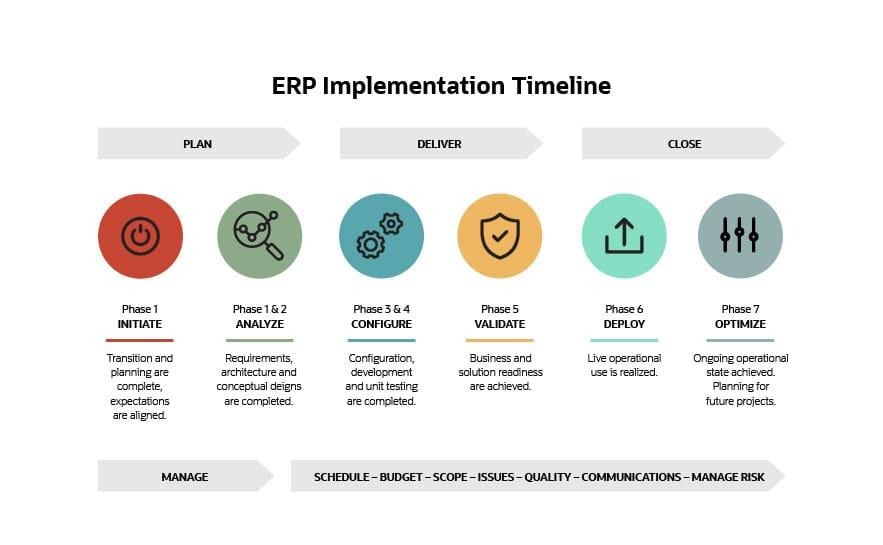
Phase 3: Data Clean-up and Migration
Legacy data deserves far more attention than it typically receives. Customers, vendors, inventory balances, and historical records must be carefully reviewed, cleansed, and validated before migration, as even the best ERP system can only be as effective as the data it contains.
Phase 4: Training
The goal of training is not to teach employees everything the ERP can do, but to ensure they know exactly how to use it for their role. Focused, hands-on training helps users become comfortable with the system, builds confidence, and significantly improves adoption after go-live.
Phase 5: User Acceptance Testing and Pilot Run
User Acceptance Testing is where the ERP system is put through real-world business scenarios by the people who will actually use it. It provides an opportunity to validate processes, identify gaps, and fine-tune the solution before go-live, ensuring the system supports the way the business truly operates.
Phase 6: Go-Live and Continued Operational Excellence
Go-Live is where months of planning, design, testing, and training finally come together. As the organization transitions to the new ERP system, the implementation team remains actively involved to support users, resolve issues quickly, and ensure minimal disruption to operations.
Implementation Verification is simultaneously performed to validate that key business processes, reports, and transactions are being utilized consistently and accurately in the live environment, providing confidence that users have successfully adopted the new system and that change management objectives have been effectively achieved.
Why Most ERP Projects in India Fail – and How to Avoid It
1: Scope creep without governance
Most ERP projects don’t fail because of a single major issue – they struggle because of dozens of small additions made along the way. New reports, additional approval workflows, custom fields, integrations, and process changes gradually expand the project’s scope, often without a clear understanding of their overall impact. Over time, what began as a structured implementation can become a collection of evolving requirements, making it difficult to maintain focus, manage expectations, and achieve a timely go-live.
The fix: Establishing a formal change control process from day one. Every addition goes through a written change request with a time and priority assessment.
2: Weak data migration planning
Weak data migrations usually fail because organizations underestimate how poor legacy data really is.
The fix: A proper migration starts with a data audit in Phase 1, not Phase 3. Waiting until later only exposes issues when systems and mappings are already built on flawed assumptions.
3: Poor requirement clarity at the start
Initial requirement gathering is often rushed or influenced by senior assumptions rather than ground-level realities. Critical edge cases and exceptions surface only during UAT or after deployment, causing rework and delays.
The fix: Investing time in deep requirement discovery using Diagnostic Questionnaire sessions, process walkthroughs, and exception understanding before design begins.
4: Inconsistent stakeholder alignment
Different departments often give conflicting requirements for the same process. Without alignment, the implementation team ends up building over-engineered workflows that satisfy no one fully.
The fix: Enforcing cross-functional sign-offs before design freeze. No single-function approvals for shared processes.
5: Weak ownership after go-live
ERP is often treated as a project that “ends” at go-live. Post-implementation ownership is unclear, leading to unresolved issues and slow system improvements. Over time, users lose trust in the system.
The fix: Establishing a dedicated ERP ownership model on both sides. The client must assign a process owner group responsible for data quality, process adherence, and continuous improvement. The consulting firm must ensure a defined post–go-live support mechanism instead of walking away at deployment.
PKC India’s ERP Consulting Practice
Most ERP consultants will tell you they implement software. At PKC, we go above and beyond – we build operational systems that actually get used.
At PKC, ERP consulting sits within a broader ecosystem of business understanding, process consulting, and audit. That context matters deeply. ERP failures are rarely technical, they are failures of business alignment.
“We don’t walk away at go-live. That’s when the real work begins.” – PKC Practice
Our recommendations are driven purely by functional fit, scalability, and implementation practicality. We assess your business model, your growth plans, your team’s capability, and your operational complexity before recommending solutions. The objective is long-term system sustainability, not short-term deployment speed.
Our implementation methodology is built around five clearly defined phase gates: Diagnose, Design, Develop, Deploy, and Drive. Each phase has formal sign-off criteria. Change control is enforced from day one. Go-live is not an endpoint but is instead a controlled transition into stabilised operations, backed by structured adoption
Why PKC:
| What PKC does | What most implementation partners do |
|---|---|
| Assess your business model, growth plans, and operational reality before touching software | Start configuration after a brief requirements call |
| Map required KPIs and metrics into the system so reports answer real business questions | Deliver standard reports without deep diving into the business requirement |
| Support employees for weeks post go-live until they’re genuinely comfortable | Conduct one-time training and close the project |
| Design controls and SOPs for areas where software cannot operate | Leave manual processes unaddressed |
Where software genuinely can’t cover a process gap, our SOP design approach fills that space with documented, trainable procedures rather than leaving it as tribal knowledge
Our teams have delivered implementations across manufacturing, distribution, retail, and professional services. We don’t arrive with a template and force-fit it to your operations. We design around your actual workflows which is why the gap between system design and ground reality, the place where most ERP value evaporates, is something we specifically close.
ERP Consulting Services in India succeed when the right ERP, the right partner, and the right approach come together. Technology alone is not enough. The outcome depends on alignment between business needs, implementation discipline, and sustained adoption after go-live.
Get those three right, and ERP stops being a project and starts becoming the way the business runs.
Frequently Asked Questions
1. What is the difference between an ERP vendor and an ERP consultant?
An ERP vendor (SAP, Oracle, Microsoft Dynamics, Zoho, Tally) builds and sells the software itself. An ERP consultant acts as the bridge between your business reality and that software – assessing process readiness, selecting the right platform, mapping your workflows onto the system, and managing the actual implementation, training, and post-go-live adoption.
2. How much does ERP implementation cost in India?
Costs vary widely based on business size, number of modules, customization needs, and data complexity. Smaller businesses with limited scope (core accounting, inventory, basic reporting) typically pay far less than mid-sized or large enterprises needing multi-module rollouts across manufacturing, supply chain, and multi-location operations. Software licensing is often only one part of the total cost – implementation, data migration, training, and post-go-live support usually add up to as much as, or more than, the software itself.
3. Why do most ERP implementations fail in India?
Most ERP failures aren’t due to bad software. They happen because the business wasn’t process-ready before implementation, requirements were rushed or unclear at the start, scope crept without a formal change-control process, data migration was underestimated, or the project was treated as “done” at go-live instead of an ongoing adoption effort.
4. What is the difference between ERP selection and ERP implementation?
ERP selection is an analytical exercise – understanding your business model, building a requirements matrix, running vendor demos, and choosing the right platform for the long term. ERP implementation is an execution-heavy phase requiring functional module expertise, data migration, training design, and change management. Not every consulting firm is equally strong at both.
5. How long does an ERP implementation take?
Timelines depend on business complexity, the number of modules, and how many locations or departments are involved. A structured engagement generally moves through defined phases – discovery and diagnosis, design and configuration, data migration, training, user acceptance testing, and go-live – with the critical 60–90 days after go-live being just as important as the rollout itself.
6. What should I look for when choosing an ERP consulting partner?
Look for a partner that studies your existing processes before recommending any software, has genuine industry-specific experience, provides a dedicated on-ground implementation team, stays flexible enough to refine the design as real usage surfaces gaps, and remains actively engaged through training, adoption, and the post-go-live stabilization period rather than exiting at deployment.
7. Is ERP implementation only for large businesses, or do small and mid-sized businesses need it too?
ERP is not exclusive to large enterprises. Family businesses, manufacturers, and mid-sized companies that have outgrown manual records, Excel-based tracking, or WhatsApp-driven coordination benefit from ERP just as much – often more, since inconsistent processes across departments or locations become harder to manage as they scale.