
 Expert verified

Introduction
Goods and Services Tax (GST) has changed the taxation system for service providers in India. Professionals such as Chartered Accountants, lawyers, consultants, architects, engineers, doctors, freelancers, management advisors, designers, and technology consultants are now required to understand GST compliance carefully. Many professionals still have practical doubts about GST registration, invoicing, reverse charge mechanism (RCM), input tax credit (ITC), e-invoicing, TDS provisions, and filing requirements. Incorrect GST compliance may lead to notices, penalties, delayed refunds, and tax disputes. This updated guide explains GST for professional services in simple language for business owners, consultants, freelancers, and professional firms. The article also includes the latest 2026 updates relating to e-invoicing, reverse charge mechanism, and the new TDS Section 393 framework under the Income Tax Act, 2025. This article is prepared for the website of PKC India, a professional services firm providing taxation, audit, advisory, and compliance services to businesses across India.r Professional Services?
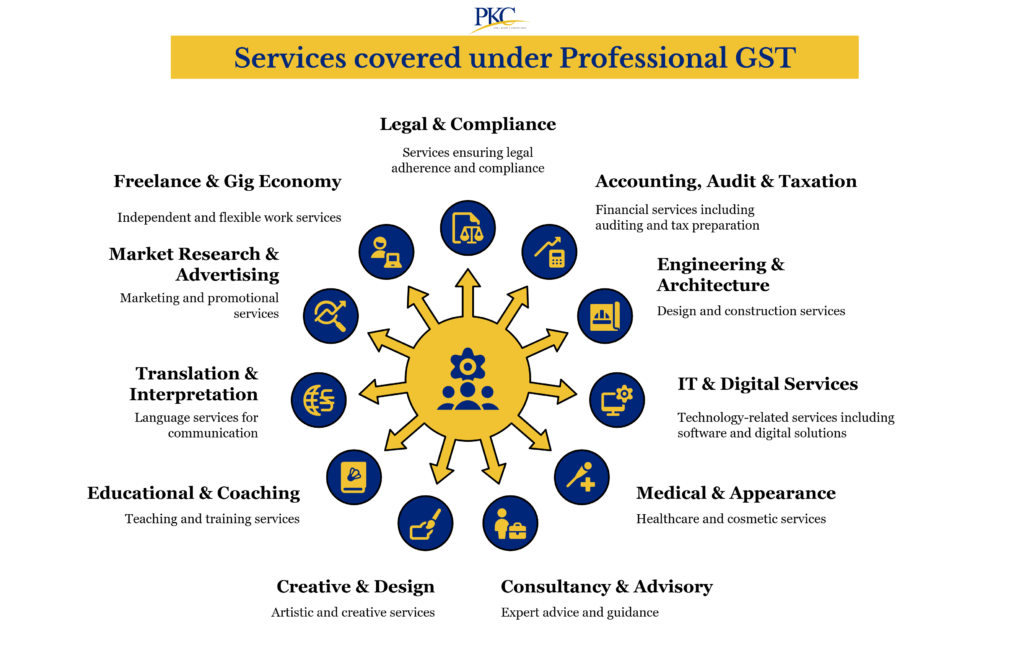
GST for professional services refers to the tax applicable on services provided by professionals and consultants. Under GST law, services provided for consideration during the course or furtherance of business are generally taxable unless specifically exempted. Professional services may include:- Chartered Accountancy services • Legal services • Consultancy services • Technical advisory • Engineering services • Architectural services • Interior design services • Digital marketing consultancy • Financial advisory • IT consultancy • Business management services • Freelancing services
Who is Considered a Professional Under GST?
The GST law does not provide a single comprehensive definition for “professional services.” In practice, professional services generally refer to specialised services provided based on qualification, expertise, training, or technical knowledge. Professionals may operate as:- Proprietorship firms • Partnership firms • LLPs • Private limited companies • Independent freelancers
GST Registration Threshold for Professional Services
One of the most important questions asked by consultants and professionals is whether GST registration is mandatory. Under GST law, service providers are generally required to obtain GST registration if aggregate turnover exceeds:- ₹20 lakh in a financial year for normal category states • ₹10 lakh in a financial year for special category states
- Taxable services • Exempt services • Export services • Interstate supplies
When GST Registration Becomes Mandatory Even Below Threshold
Certain situations may require GST registration even if turnover is below ₹20 lakh. Examples include:- Interstate taxable supplies in specified situations • E-commerce operator-related services in certain cases • Reverse charge applicability • Voluntary registration • Input tax credit planning • Requirement by clients or contracts
GST Rate for Professional Services
Most professional services are taxable at 18% GST. This usually consists of:- 9% CGST + 9% SGST for intra-state services OR • 18% IGST for interstate services
- CA services • Legal consultancy by law firms • Management consultancy • Engineering consultancy • IT consultancy • Recruitment consultancy • Interior design services • Marketing consultancy
GST Exemptions for Certain Professional Services
Certain professional services may enjoy GST exemption subject to conditions. Examples may include:- Healthcare services by clinical establishments and authorized medical practitioners • Certain educational services • Services provided by advocates to non-business entities in specified cases • Agricultural extension services in specified cases
Time of Supply for Professional Services
Under GST, tax liability generally arises at the earlier of:- Date of invoice OR • Date of payment
Place of Supply for Professional Services
Determining the place of supply is important because it affects whether CGST-SGST or IGST is charged. For most B2B professional services: Place of supply is generally the location of the registered recipient. For B2C services: Place of supply may depend on the location of the recipient or supplier based on the nature of services. Incorrect place of supply determination may result in wrong tax payment and future disputes. For a detailed breakdown of how place of supply determines whether CGST+SGST or IGST applies to your invoices, read our complete guide on CGST vs SGST vs IGST.GST Invoice Requirements for Professional Services
A GST invoice for professional services generally contains:- Name and address of supplier • GSTIN • Invoice number and date • Client details • Description of services • SAC code • Taxable value • GST rate and tax amount • Place of supply • Signature or digital authentication
SAC Code for Professional Services
SAC stands for Services Accounting Code. Different professional services fall under different SAC classifications. Examples:- Accounting and auditing services • Legal services • Architectural services • Information technology consultancy services • Management consultancy services
Input Tax Credit (ITC) for Professional Services
Input Tax Credit is one of the most important benefits under GST. Professionals can generally claim ITC on GST paid for business-related expenses used in the course of providing taxable services. Examples where ITC may generally be available:- Office rent • Professional software subscriptions • Internet expenses • Office equipment • Audit and consultancy expenses • Business travel expenses • Staff training expenses • Telephone and communication expenses
ITC Eligibility Table for Professional Services
Eligible for ITC- Office rent used for business • Laptop and computer purchases • Accounting software • Professional subscriptions • Internet and telephone bills • Office stationery • Consultancy services received • GST paid on business travel subject to conditions
- Personal expenses • Motor vehicles in many cases • Club memberships • Food and beverages in many cases • Personal travel expenses • Employee-related personal consumption • Expenses without proper GST invoices
Composition Scheme for Professionals
Earlier, professionals had limited applicability under composition schemes. Over time, GST law introduced composition options for certain service providers subject to turnover conditions. Professionals considering composition schemes should evaluate:- Reduced compliance benefits • Restrictions on ITC • Restrictions on interstate supplies in certain cases • Lower tax rates • Client expectations regarding GST invoices
GST Returns Applicable to Professionals
Professionals registered under GST may be required to file:- GSTR-1 • GSTR-3B • Annual return in applicable cases
- Late fees • Interest liability • ITC blockage • Compliance notices
E-Invoicing for Professional Services Firms — Mandatory from ₹5Cr Turnover
E-invoicing has become an important compliance requirement under GST. As applicable in 2026, businesses crossing prescribed turnover thresholds are required to generate e-invoices through the Invoice Registration Portal (IRP). Professional services firms with aggregate turnover exceeding ₹5 crore are required to comply with e-invoicing requirements, subject to applicable GST notifications and amendments. Under e-invoicing:- Invoice data is uploaded to the IRP • Invoice Reference Number (IRN) is generated • QR code is generated • Invoice becomes GST-compliant for reporting purposes
Why E-Invoicing is Important for Professionals
E-invoicing helps:- Reduce invoice mismatches • Improve GST reporting accuracy • Reduce fake invoice risks • Simplify reconciliation • Improve compliance tracking
Consequences of Non-Compliance with E-Invoicing
If e-invoicing is applicable but invoices are not generated through the prescribed system:- Invoice may be treated as invalid • ITC issues may arise for clients • GST penalties may apply • Compliance notices may be issued
What is RCM Under GST for Professional Services — Updated 2026 List
Reverse Charge Mechanism (RCM) means GST liability shifts from the supplier to the recipient in specified cases. Certain professional services continue to fall under RCM in 2026. Examples generally covered under RCM include:- Legal Services by Advocates
- Director Services
- Certain Services by Chartered Accountants and Professionals
- Sponsorship Services
- Import of Services
- Pay GST directly • Report liability properly • Maintain documentation • Claim ITC subject to eligibility
New TDS Section 393 — What Changed from April 2026
From 1 April 2026, the Income Tax Act, 2025 introduced structural changes in TDS provisions. The earlier TDS framework under Section 194J of the Income-tax Act, 1961 has now been reorganized under Section 393 of the Income Tax Act, 2025 for specified non-salary payments. citeturn0search0turn0search3turn0search12 The objective of the new structure is simplification and consolidation of TDS provisions. Key practical points for professional services:- Professional fees continue to attract TDS provisions • Reporting structure has changed under the new Act • Section references in returns and certificates may change • Businesses should update accounting and ERP systems accordingly
GST Compliance Checklist for CA Firms and Consultants
Professional firms should maintain a practical GST compliance process. Basic GST Checklist Registration- Verify GST registration applicability • Update principal place of business • Review additional place registrations
- Use correct GST rates • Mention SAC codes • Verify client GSTIN • Generate e-invoice where applicable
- File GSTR-1 on time • File GSTR-3B on time • Reconcile turnover periodically
- Match vendor invoices • Reconcile GSTR-2B • Review blocked credits • Verify expense eligibility
- Identify RCM transactions • Pay GST under RCM • Report properly in returns
- Maintain agreements • Preserve invoices • Keep payment records • Maintain reconciliation statements
- Verify turnover thresholds • Review e-invoicing applicability • Conduct GST health check • Review notices and litigation exposure
GST on Export of Professional Services
Export of services may qualify as zero-rated supply subject to conditions. To qualify as export of services:- Supplier should be located in India • Recipient should be outside India • Place of supply should be outside India • Payment should be received in convertible foreign exchange or permitted modes • Supplier and recipient should not merely be establishments of the same entity
GST for Freelancers and Independent Consultants
Freelancers are also covered under GST provisions if turnover crosses registration thresholds. Common freelancers covered include:- Content writers • Designers • Digital marketers • Technology consultants • Trainers • Business consultants • YouTubers and influencers in certain cases
Common GST Mistakes Made by Professionals
Some common compliance mistakes include:- Delayed GST registration • Wrong place of supply determination • Incorrect GST rate usage • Failure to reconcile GSTR-2B • Missing RCM liability • Improper ITC claims • Failure to maintain agreements • Incorrect export treatment • Non-compliance with e-invoicing
Penalties Under GST for Professionals
GST law prescribes penalties for various defaults. Possible consequences may include:- Late fees for delayed returns • Interest on delayed tax payment • Penalty for non-registration • Wrong ITC claims • Incorrect invoicing • Non-payment under RCM • Non-compliance with e-invoicing
Technology and GST Compliance
Technology has become important for GST management. Professional firms now commonly use:- GST-enabled accounting software • Automated reconciliation tools • E-invoicing integration systems • Cloud accounting platforms • GST analytics dashboards
Conclusion
GST compliance for professional services has become more structured and technology-driven. Professionals and consulting firms must carefully monitor registration thresholds, invoicing requirements, reverse charge provisions, ITC eligibility, and filing obligations. With the introduction of e-invoicing for higher turnover firms and the structural changes introduced under the Income Tax Act, 2025 relating to TDS reporting, businesses should strengthen compliance systems and documentation practices. A proactive approach helps reduce litigation risk, avoid penalties, improve client confidence, and maintain smooth business operations. Professional firms should periodically review GST applicability, conduct reconciliations, and obtain professional guidance wherever required.References
- Central Goods and Services Tax Act, 2017
- GST Notifications and Circulars relating to professional services and reverse charge mechanism
- Income Tax Act, 2025 — Section 393 references
- Income Tax Department FAQs and section mapping documents
Frequently Asked Questions
- Is GST mandatory for professionals in India?
- What is the GST rate for professional services?
- Is e-invoicing mandatory for professional firms?
- Can professionals claim input tax credit?
- Does reverse charge apply to legal services?
- What is the GST registration limit for service providers?
- What changed under TDS Section 393 from April 2026?
Introduction
Goods and Services Tax (GST) has changed the taxation system for service providers in India. Professionals such as Chartered Accountants, lawyers, consultants, architects, engineers, doctors, freelancers, management advisors, designers, and technology consultants are now required to understand GST compliance carefully. Many professionals still have practical doubts about GST registration, invoicing, reverse charge mechanism (RCM), input tax credit (ITC), e-invoicing, TDS provisions, and filing requirements. Incorrect GST compliance may lead to notices, penalties, delayed refunds, and tax disputes. This updated guide explains GST for professional services in simple language for business owners, consultants, freelancers, and professional firms. The article also includes the latest 2026 updates relating to e-invoicing, reverse charge mechanism, and the new TDS Section 393 framework under the Income Tax Act, 2025. This article is prepared for the website of PKC India, a professional services firm providing taxation, audit, advisory, and compliance services to businesses across India.What is GST for Professional Services?
GST for professional services refers to the tax applicable on services provided by professionals and consultants. Under GST law, services provided for consideration during the course or furtherance of business are generally taxable unless specifically exempted. Professional services may include:- Chartered Accountancy services • Legal services • Consultancy services • Technical advisory • Engineering services • Architectural services • Interior design services • Digital marketing consultancy • Financial advisory • IT consultancy • Business management services • Freelancing services
Who is Considered a Professional Under GST?
The GST law does not provide a single comprehensive definition for “professional services.” In practice, professional services generally refer to specialised services provided based on qualification, expertise, training, or technical knowledge. Professionals may operate as:- Proprietorship firms • Partnership firms • LLPs • Private limited companies • Independent freelancers
GST Registration Threshold for Professional Services
One of the most important questions asked by consultants and professionals is whether GST registration is mandatory. Under GST law, service providers are generally required to obtain GST registration if aggregate turnover exceeds:- ₹20 lakh in a financial year for normal category states • ₹10 lakh in a financial year for special category states
- Taxable services • Exempt services • Export services • Interstate supplies
When GST Registration Becomes Mandatory Even Below Threshold
Certain situations may require GST registration even if turnover is below ₹20 lakh. Examples include:- Interstate taxable supplies in specified situations • E-commerce operator-related services in certain cases • Reverse charge applicability • Voluntary registration • Input tax credit planning • Requirement by clients or contracts
GST Rate for Professional Services
Most professional services are taxable at 18% GST. This usually consists of:- 9% CGST + 9% SGST for intra-state services OR • 18% IGST for interstate services
- CA services • Legal consultancy by law firms • Management consultancy • Engineering consultancy • IT consultancy • Recruitment consultancy • Interior design services • Marketing consultancy
GST Exemptions for Certain Professional Services
Certain professional services may enjoy GST exemption subject to conditions. Examples may include:- Healthcare services by clinical establishments and authorized medical practitioners • Certain educational services • Services provided by advocates to non-business entities in specified cases • Agricultural extension services in specified cases
Time of Supply for Professional Services
Under GST, tax liability generally arises at the earlier of:- Date of invoice OR • Date of payment
Place of Supply for Professional Services
Determining the place of supply is important because it affects whether CGST-SGST or IGST is charged. For most B2B professional services: Place of supply is generally the location of the registered recipient. For B2C services: Place of supply may depend on the location of the recipient or supplier based on the nature of services. Incorrect place of supply determination may result in wrong tax payment and future disputes.GST Invoice Requirements for Professional Services
A GST invoice for professional services generally contains:- Name and address of supplier • GSTIN • Invoice number and date • Client details • Description of services • SAC code • Taxable value • GST rate and tax amount • Place of supply • Signature or digital authentication
SAC Code for Professional Services
SAC stands for Services Accounting Code. Different professional services fall under different SAC classifications. Examples:- Accounting and auditing services • Legal services • Architectural services • Information technology consultancy services • Management consultancy services
Input Tax Credit (ITC) for Professional Services
Input Tax Credit is one of the most important benefits under GST. Professionals can generally claim ITC on GST paid for business-related expenses used in the course of providing taxable services. Examples where ITC may generally be available:- Office rent • Professional software subscriptions • Internet expenses • Office equipment • Audit and consultancy expenses • Business travel expenses • Staff training expenses • Telephone and communication expenses
ITC Eligibility Table for Professional Services
Eligible for ITC- Office rent used for business • Laptop and computer purchases • Accounting software • Professional subscriptions • Internet and telephone bills • Office stationery • Consultancy services received • GST paid on business travel subject to conditions
- Personal expenses • Motor vehicles in many cases • Club memberships • Food and beverages in many cases • Personal travel expenses • Employee-related personal consumption • Expenses without proper GST invoices
Composition Scheme for Professionals
Earlier, professionals had limited applicability under composition schemes. Over time, GST law introduced composition options for certain service providers subject to turnover conditions. Professionals considering composition schemes should evaluate:- Reduced compliance benefits • Restrictions on ITC • Restrictions on interstate supplies in certain cases • Lower tax rates • Client expectations regarding GST invoices
GST Returns Applicable to Professionals
Professionals registered under GST may be required to file:- GSTR-1 • GSTR-3B • Annual return in applicable cases
- Late fees • Interest liability • ITC blockage • Compliance notices
E-Invoicing for Professional Services Firms — Mandatory from ₹5Cr Turnover
E-invoicing has become an important compliance requirement under GST. As applicable in 2026, businesses crossing prescribed turnover thresholds are required to generate e-invoices through the Invoice Registration Portal (IRP). Professional services firms with aggregate turnover exceeding ₹5 crore are required to comply with e-invoicing requirements, subject to applicable GST notifications and amendments. Under e-invoicing:- Invoice data is uploaded to the IRP • Invoice Reference Number (IRN) is generated • QR code is generated • Invoice becomes GST-compliant for reporting purposes
Why E-Invoicing is Important for Professionals
E-invoicing helps:- Reduce invoice mismatches • Improve GST reporting accuracy • Reduce fake invoice risks • Simplify reconciliation • Improve compliance tracking
Consequences of Non-Compliance with E-Invoicing
If e-invoicing is applicable but invoices are not generated through the prescribed system:- Invoice may be treated as invalid • ITC issues may arise for clients • GST penalties may apply • Compliance notices may be issued
What is RCM Under GST for Professional Services — Updated 2026 List
Reverse Charge Mechanism (RCM) means GST liability shifts from the supplier to the recipient in specified cases. Certain professional services continue to fall under RCM in 2026. Examples generally covered under RCM include:- Legal Services by Advocates
- Director Services
- Certain Services by Chartered Accountants and Professionals
- Sponsorship Services
- Import of Services
- Pay GST directly • Report liability properly • Maintain documentation • Claim ITC subject to eligibility
New TDS Section 393 — What Changed from April 2026
From 1 April 2026, the Income Tax Act, 2025 introduced structural changes in TDS provisions. The earlier TDS framework under Section 194J of the Income-tax Act, 1961 has now been reorganized under Section 393 of the Income Tax Act, 2025 for specified non-salary payments. citeturn0search0turn0search3turn0search12 The objective of the new structure is simplification and consolidation of TDS provisions. Key practical points for professional services:- Professional fees continue to attract TDS provisions • Reporting structure has changed under the new Act • Section references in returns and certificates may change • Businesses should update accounting and ERP systems accordingly
GST Compliance Checklist for CA Firms and Consultants
Professional firms should maintain a practical GST compliance process. Basic GST Checklist Registration- Verify GST registration applicability • Update principal place of business • Review additional place registrations
- Use correct GST rates • Mention SAC codes • Verify client GSTIN • Generate e-invoice where applicable
- File GSTR-1 on time • File GSTR-3B on time • Reconcile turnover periodically
- Match vendor invoices • Reconcile GSTR-2B • Review blocked credits • Verify expense eligibility
- Identify RCM transactions • Pay GST under RCM • Report properly in returns
- Maintain agreements • Preserve invoices • Keep payment records • Maintain reconciliation statements
- Verify turnover thresholds • Review e-invoicing applicability • Conduct GST health check • Review notices and litigation exposure
GST on Export of Professional Services
Export of services may qualify as zero-rated supply subject to conditions. To qualify as export of services:- Supplier should be located in India • Recipient should be outside India • Place of supply should be outside India • Payment should be received in convertible foreign exchange or permitted modes • Supplier and recipient should not merely be establishments of the same entity
GST for Freelancers and Independent Consultants
Freelancers are also covered under GST provisions if turnover crosses registration thresholds. Common freelancers covered include:- Content writers • Designers • Digital marketers • Technology consultants • Trainers • Business consultants • YouTubers and influencers in certain cases
Common GST Mistakes Made by Professionals
Some common compliance mistakes include:- Delayed GST registration • Wrong place of supply determination • Incorrect GST rate usage • Failure to reconcile GSTR-2B • Missing RCM liability • Improper ITC claims • Failure to maintain agreements • Incorrect export treatment • Non-compliance with e-invoicing
Penalties Under GST for Professionals
GST law prescribes penalties for various defaults. Possible consequences may include:- Late fees for delayed returns • Interest on delayed tax payment • Penalty for non-registration • Wrong ITC claims • Incorrect invoicing • Non-payment under RCM • Non-compliance with e-invoicing
Technology and GST Compliance
Technology has become important for GST management. Professional firms now commonly use:- GST-enabled accounting software • Automated reconciliation tools • E-invoicing integration systems • Cloud accounting platforms • GST analytics dashboards
Conclusion
GST compliance for professional services has become more structured and technology-driven. Professionals and consulting firms must carefully monitor registration thresholds, invoicing requirements, reverse charge provisions, ITC eligibility, and filing obligations. With the introduction of e-invoicing for higher turnover firms and the structural changes introduced under the Income Tax Act, 2025 relating to TDS reporting, businesses should strengthen compliance systems and documentation practices. A proactive approach helps reduce litigation risk, avoid penalties, improve client confidence, and maintain smooth business operations. Professional firms should periodically review GST applicability, conduct reconciliations, and obtain professional guidance wherever required.References
- Central Goods and Services Tax Act, 2017
- GST Notifications and Circulars relating to professional services and reverse charge mechanism
- Income Tax Act, 2025 — Section 393 references
- Income Tax Department FAQs and section mapping documents
Frequently Asked Questions
- Is GST mandatory for professionals in India?
- What is the GST rate for professional services?
- Is e-invoicing mandatory for professional firms?
- Can professionals claim input tax credit?
- Does reverse charge apply to legal services?
- What is the GST registration limit for service providers?
- What changed under TDS Section 393 from April 2026?